


Why didn’t Jesus come as the King of the world among a powerful nation, and an exceptional throng of people that could influence a worldly empire, instead of riding upon a donkey? Perhaps the plan was to evolve differently, but the tribal people of God’s choosing weren’t up to that more expected, international, and glorious setting. The sorry story of a failed people and the violent death of their Messiah, though, sets up the background for what happened next. Death has been conquered.
Tuesday of the Fourth Week in Ordinary Time
Numbers 21:4-9
John 8:21-30
Why does scripture present us with God as Jesus, the Christ? An all-powerful and mighty God, a Father of us all, who made the universe and everything in it, isn’t enough? It’s logical, too, that the Spirit of God travels through the wind and whispers into our ears all that the Father wants us to do and accomplish. Isn’t that enough?
As odd as it is, no, that’s not enough.
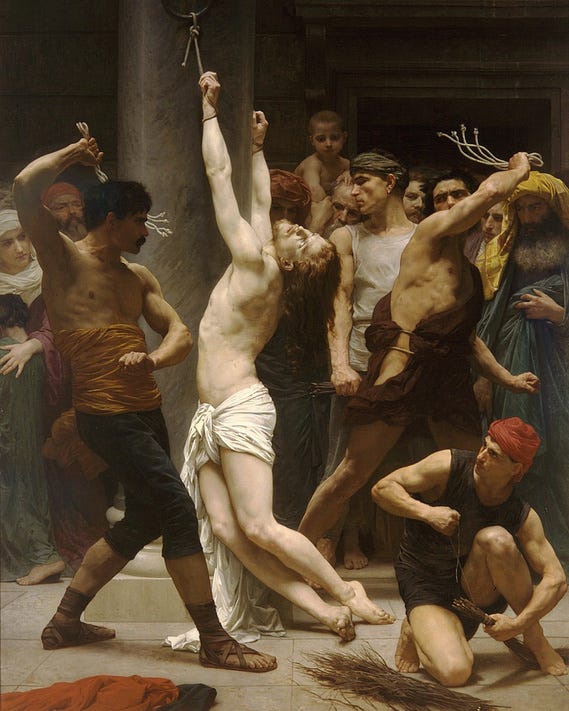
It’s not so much that something is wrong with the reality of a God who created everything and lives with us all in his Spirit. God wants more than recognition. He wants to be among us in the flesh, to live and die as we do — humiliated, ravaged in age or some other horror. He wasn’t a contrived revelation or a creative addition to the universe. He is the true holy manifestation, a materialized person of the Father and the Holy Spirit who pre-existed creation itself.
The cosmic divinity of God is above my pay grade. Let’s just land on this: God decided all along (or, whatever you call “before time”) that he wanted to be one of us, among us, as shepherd, kin, king, victim, and redeemer.
“The one who sent me is with me.
He has not left me alone,
because I always do what is pleasing to him.”
God the Father and the Holy Spirit didn’t tack on a holy human trope, a puppet to delight us. This Jesus is an essential, existential character of God, tied to the sails of the Holy Spirit, and the engine of the Father, as a ship on wild waters. (Metaphors are less logical the more you review them.)
Jesus is our human and divine Lord. We must believe and follow a flesh and bones being like us, not for a season, a term, or an age, but for all eternity.
Not to skip over the fact that this reality came from the words and teaching of Jesus. It’s important to show the receipts, credentials, and provenance of this Trinitatian God. He clearly defined the person of God as Father, and the Spirit of God as Holy. No one else told us this, based on human calculations and concoctions. It sounds silly to attribute this to a notion made up by Moses or St. Paul, two fellas from over town.
In addition, the earthly manifestations of God had already been revealed in pillars of fire and cloud, a burning bush, and in incredible displays of warfare and miraculous rescues. Angels, too, announced God’s presence. They weren’t aliens from another planet, but “pre-time” (a waffly dating) creatures. God also spoke to prophets and called himself “I Am.”
From the earliest records of the Hebrew scriptures, the Messiah, the Christ, was foretold. But the shocking reality that Jesus was among the singular God, revealed in a trinity of persons, was not articulated until Christ himself claimed, “I am.” Until he said it, no one knew the assurance of Jesus’ divinity.
“When you lift up the Son of Man,
then you will realize that I AM …”
Unlike the God of fire and cloud, whose voice dropped people to their knees, spread the waters to free people, and drowned armies, Jesus healed outcasts and cured peasants. Unlike his Holy Spirit, who touched every living thing not just over the eons and around the globe, but throughout the universe, this Jesus bar Joseph led a regionally bounded and lackluster life growing up as a carpenter’s stepson. After 30 years of an ignominious existence, Jesus revealed his divinity and asserted his Lordship by spending a mere three years on a mission with a blue-collar band of unexceptional people in a place the size of a few Colorado counties.
This Jesus amazed and rankled a tiny portion of one tiny planet among bazzilions (innumerable billions) of interstellar environs. Basically, a place the size of a molecule on a gnat’s whisker. Jesus Christ ruffled the religious leaders of an odd-looking, ritual-obsessed, and politically and militarily failed small community of tribal origin. He didn’t conquer Rome. He was conquered and killed by an annoying, unruly people who no longer had land of their own, and their leaders had severely restricted powers.
The Jews were the conquered remnant of a dozen nomadic tribes. An unfortunate disintegration of the wealthiest ruler in ancient history, to be fair, but a testament to Jesus’ divine arrival among a weakened people held under the thumb of two pompous overlords — the Pharisees and the Romans.
Jesus’ interactions and miraculous activities took place under an unimportant umbrella in a concealed corner of one empire. During his lifetime, his efforts intrigued only a couple of local Roman officials curious about his parochial celebrity. Without much consideration and less legal weight, the local Roman landlords acquiesced to unreasonable clerics and a protesting horde of their supporters. They crucified Jesus like a common criminal, mocked as a King of not just Jews, but also the Romans and Greeks. His murder was assumed to be another annoying and forgotten execution.
Why didn’t Jesus come as the King of the world among a powerful nation, and an exceptional throng of people that could influence a worldly empire, instead of riding upon a donkey? The plan was meant to evolve differently, but the tribal people of God’s choosing weren’t up to the task. This story of a people of history selected to be the beacon of the God of the universe tells us they were unprepared to convince anyone that Jesus was the Lord of the universe or that he sat upon a throne as the second person of the Holy Trinity. The sorry tale of a failed people and the violent death of their Messiah, though, sets up the background for what happened next.
Because he was God, assisted in both influence and indwelling by the Holy Spirit, Jesus placed himself, as we should be, under the guidance and order of the Father. He did this with a dramatic and epic reveal.
Jesus then rose from the dead. Resurrection is our future.
His prophecy and promise during his missionary life came to fulfillment. This is all that matters to a world of evidentiary truth. Show me that this man is Lord, say the interpreters of history, and ardent study with the gift of faith will do just that.
To rise from the dead as a resurrected being with capabilities and powers that astound science stamps a divine seal on the conqueror of death. The risen Jesus countermands a decaying premise of creation’s design. Jesus turned upside down, or rather upside right, the foundation of creation. He rose so that everyone, for all time, will have a marker that distinguishes Jesus from any other man by exposing a better eventuality.
The original and only logical expectation of a holy creator is that all creation will have eternal life. To deny that, in the face of Jesus’ revolutionary exclamation of life forever under his tutelage, relegates us to a doomed, deadly end, left with eternal existence, but without the feasting and beatific vision.
“If you confess with your mouth that Jesus is Lord, and believe in your heart that God raised him from the dead, you will be saved.” Romans 10:9
The simple truth of Jesus as Lord, shown in the dusty countryside of Jerusalem, is told today in the same parochial and insignificant fashion. We humans, in our leadership and worldview, remain a failed partner with Jesus, the Father of us all, and the Holy Spirit who yearns to live in us.
Regardless of the concentration upon the glorious Vatican compound and the remarkable cathedrals that dot every city on the globe, the truth of Jesus as Lord, as the risen Son of God, is primarily told on the streets, in the neighborhoods, on automobile bumpers, and in the common gathering places of the world. The vast majority of Christian testimony takes place beneath and outside the pantheons of government councils, executive boardrooms, and mansions of the wealthy.
And still, the testimony powerfully transforms the population.
We bless our meals in the name of the God who lives, offering up our thanks to “Christ our Lord, Amen.” We discuss our families and mention the ones that are sick, upset, lost, anxious, and maybe dying. We casually and sincerely add all these people to our prayers, mouthing “We pray to the Lord” and “Lord hear our prayer,” while we drink coffee and tea and enjoy each other’s company.
We are witnesses, testifying among each other, and in public. “No one who believes in him will be put to shame.” In almost all such cases of shared faith, restaurant managers and serving staff, others around us on the beach, and those who hear us on the subway, all bow their hearts, encouraging us to be faithful.
Our thinking and attention must be formed and focused toward a singular relationship to one man, scripture tells us. We gather in faith, hold hands in prayer, and object to Jesus' insults by changing the reception on our radios, the channels on our televisions, and the images on our phones. The airwaves and digital spaces offer plenty of faithful options and opportunities. We have even chosen to teach our children at home when no other choices exist. The effect of eternal life is unstoppable.
So, many of us wear crosses to remind us, some attached to rosaries, and others hanging from our rear-view mirrors. Our churches display the cross of the man, and we enter in packs and droves to make our statement with our feet. Our churches are everywhere, whether common in their space or glorious in their steeples.
While many of us may struggle to grasp that an all-powerful and loving God exists, the seemingly complicated story of an obscure birth, life, and death has morphed into a perfectly good notion of the almighty that has crashed through the barrier of the invisible. We shake each other’s hands at our services and claim the Spirit’s urging. “Christ be with you.”
When someone curses, “Jesus Christ,” we murmur the added words and finish their sentence with, “is Lord.” When we see old friends, and they exclaim their shock at seeing us, “Jesus Christ, it’s you!” We answer, “No. It’s just me, John. But thanks for seeing him in me.”
God insists that the basis for everything we should believe rests on this single, central, recurring statement: Jesus is Lord. He’s the Lord of me, he’s the Lord of all. Lordy, Lordy, Lordy.
We are told that at the core of our being, in our heart, our acceptance must be resolute and confident enough to confess that belief out loud, and the simplest expressions are the ones that course through society where two or three are gathered.
We do this because “Their voice has gone forth to all the earth, and their words to the ends of the world.”
(Oh, and Jesus is returning, likely in the international and glorious visage that we think is more appropriate. However, the “how” will be just as unexpected.)
[A rewrite of my OMG reflection from 11-30-16]