


In Matthew, followers are identified as lost followers. Lots of followers. Indeed, abundant followers. This is the harvest that Jesus has identified. The statement “to ask the master of the harvest to send out laborers” is like Jesus saying, “Note to self: I need to get some help in reaching these lost souls.”
Tuesday of the Fourteenth Week in Ordinary Time
Hosea 8:4-7, 11-13
Matthew 9:32-38
A couple of weeks ago, I went to a store in Colorado Springs to trade a few assembled LEGO kits (mostly Star Wars oriented) for kits and parts that would be more at home with my Christmas (LEGO calls it Winter Village) layout that I have been working on with my grandkids for a bunch of years.
I brought my trading stock to the desk in the back of the store for evaluation, then walked around to see if there were any new, used, or “my own creations” (custom-built LEGO constructions about anything you could imagine) that would suggest Christmas in the mountains. Things on my “it would be nice” list include a train decorated for the holidays, a Christmas tree lot, and a retired Gingerbread House kit from 2019.
When I got to the new kits part of the store, there were several categories, including race cars, flowers (they call them “Botanicals”), new offerings for Star Wars, Harry Potter, and Lord of the Rings fans, and a bunch of other categories. The item that caught my attention, though, was the “Lionel Messi – Celebration” set.
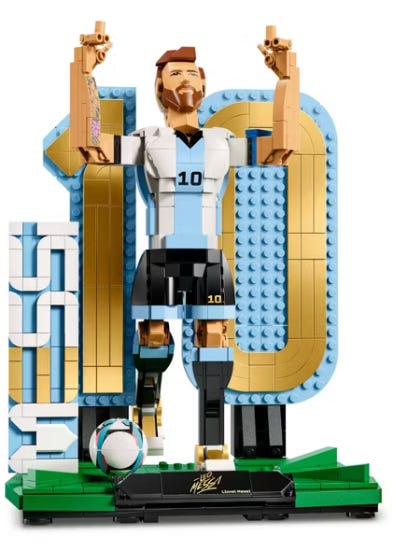
The LEGO Editions Lionel Messi – Celebration (43018) set is a 1,427‑piece premium display model that recreates Messi in his iconic victory pose — arms raised, number 10 jersey, and a stylized backdrop designed for wall mounting. It’s part of LEGO’s Editions Football line, aimed at collectors and sports fans ages 14+. I will admit that I wasn’t exactly sure of who he was, but my first thought was “Who would want something like that?” I mean, he is just a single member of a single team who must be pretty hot right now.
My friends at Wikipedia enlightened me. Lionel Andrés Messi is an Argentine professional footballer widely considered one of the greatest in history. Captain of Inter Miami and Argentina, he holds records including 8 Ballon d’Ors, 46 team trophies, over 900 career goals, and 400+ assists. He has won the 2022 World Cup, 2021 and 2024 Copa América, 4 Champions Leagues with Barcelona, and back-to-back MLS MVPs in 2024 and 2025. He is a G.O.A.T. – Greatest Of All Time.
The set sells for $199.99 but does not seem to be selling well (or at all) in the Colorado Springs store. Somewhere along the line, though, someone at LEGO must have felt there was enough hero worship to justify mass-producing the set.
I finished my trade and used some of my store credit to purchase a LEGO Christmas Tree and a cocoa stand that would look nice on the town square in my plastic-brick diorama.
So, what does all of this have to do with today’s readings? Quite a bit, perhaps.
Before we do a deeper dive, let’s review the first two of the Ten Commandments:
• Thou shalt not have any other gods before God.
The long form is:
I am the LORD your God, who brought you out of the land of Egypt, out of the house of slavery. You shall not have other gods beside me. [Exodus 20:2-3]
Not merely the greatest god, but the only God. THE God. The God Of All Time. The original and only G.O.A.T. The second commandment piggy-backs on the first.
• Thou shalt not make yourself an idol.
The Old Testament text is a bit more elaborate:
You shall not make for yourself an idol or a likeness of anything in the heavens above or on the earth below or in the waters beneath the earth; you shall not bow down before them or serve them. For I, the LORD, your God, am a jealous God, inflicting punishment for their ancestors’ wickedness on the children of those who hate me, down to the third and fourth generation; but showing love down to the thousandth generation of those who love me and keep my commandments. [Exodus 20:4-6]
The problem is not just in crafting an object, but in bowing down before or serving it. Sometimes referred to as idol worship. God sees that as a form of hate against him and assures us that he WILL inflict punishment for violations.
Our first reading is from the book of Hosea.
Hosea, a prophet from the Northern Kingdom, preached in his homeland, which he addresses as Israel, Jacob, or, frequently, Ephraim. Hosea began his mission in a period of prosperity, the last years of Jeroboam II (783–743 B.C.). This was followed by a period of internal instability, with intrigues at the royal court leading to the assassination of several kings.
Hosea is specifically addressing God’s displeasure with the actions of King Jeroboam detailed in 1 Kings:
Jeroboam thought to himself: “Now the kingdom will return to the house of David. If this people go up to offer sacrifices in the house of the LORD in Jerusalem, the hearts of this people will return to their master, Rehoboam, king of Judah, and they will kill me and return to Rehoboam, king of Judah.” The king took counsel, made two calves of gold, and said to the people: “You have been going up to Jerusalem long enough. Here are your gods, O Israel, who brought you up from the land of Egypt.” And he put one in Bethel, the other in Dan. This led to sin, because the people frequented these calves in Bethel and in Dan. [1 Kings 12:26-30]
Like other prophets, Hosea issues God’s warning:
They made kings, but not by my authority; they established princes, but without my knowledge. With their silver and gold they made idols for themselves, to their own destruction. He has rejected your calf, Samaria! My wrath is kindled against them; How long will they be incapable of innocence in Israel? An artisan made it, it is no god at all. The calf of Samaria will be dashed to pieces. [Hosea 8:4-6]
And concludes with a judgment call from the God Of All Time:
They love sacrifice; they sacrifice meat and eat it, but the LORD is not pleased with them. Now he will remember their guilt and punish their sins; they shall return to Egypt. [Hosea 8:13]
The Psalm reading today is a response to an idol-worshiping enemy taunting the Israelites with “Where is your God?”
The psalmist assures us that God is in charge: Our God is in heaven and does whatever he wills. [Psalm 115:3]
And then he gives a comprehensive list of what is wrong with the idols the enemy worships:
Their idols are silver and gold, the work of human hands. They have mouths but do not speak, eyes but do not see. They have ears but do not hear, noses but do not smell. They have hands but do not feel, feet but do not walk; they produce no sound from their throats. [Psalm 115:4-7]
Not unlike an expensive LEGO wall hanging. The response given is: The house of Israel trusts in the Lord [Psalm 115:9]. The house of Israel recognizes The God Of All Time, the real G.O.A.T.
Our gospel reading is a two-fer. The first part follows a long list of other healings in previous chapters of Matthew, but with an additional twist.
A demoniac who could not speak was brought to Jesus, and when the demon was driven out, the mute man spoke. The crowds were amazed and said, “Nothing like this has ever been seen in Israel.” But the Pharisees said, “He drives out demons by the prince of demons.” [Matthew 9:32-34]
This is one of the first times the Pharisees observe God's power manifested in Jesus, but they get the reason for his success completely backward. Their conclusion appears to be based on the fact that they could not do this with their relationship with God, so it must be the work of Satan. They could argue that under the first commandment, they were not putting any other god before God. To them, Jesus was not yet recognized as the Son of God.
Jesus went around to all the towns and villages, teaching in their synagogues, proclaiming the Gospel of the Kingdom, and curing every disease and illness. [Matthew 9:35]
Then Jesus sees that this work, God’s work, will need to be addressed in new ways in order to be more effective in reaching those in need.
At the sight of the crowds, his heart was moved with pity for them because they were troubled and abandoned, like sheep without a shepherd. Then he said to his disciples, “The harvest is abundant, but the laborers are few; so ask the master of the harvest to send out laborers for his harvest.” [Matthew 9:36-38]
Followers identified as lost followers. Lots of followers. Indeed, abundant followers. This is the harvest that Jesus has identified. The statement to “ask the master of the harvest to send out laborers” is like Jesus saying, “Note to self: I need to get some help in reaching these lost souls.”
The solution will be found in the next verse of the Gospel of Matthew, at the beginning of chapter 10: Jesus summoned his Twelve disciples and gave them authority over unclean spirits to drive them out and to cure every disease and every illness [Matthew 10:1].
These are the very powers that the Pharisees were unable to understand and perform. Jesus, the lamb of God, gives authority to his selected apostles, and they begin to do God’s work amongst the lost sheep, the harvest.
Which G.O.A.T. is Jesus? The Greatest of All Time or The God of All Time?
Yes, he is both.