


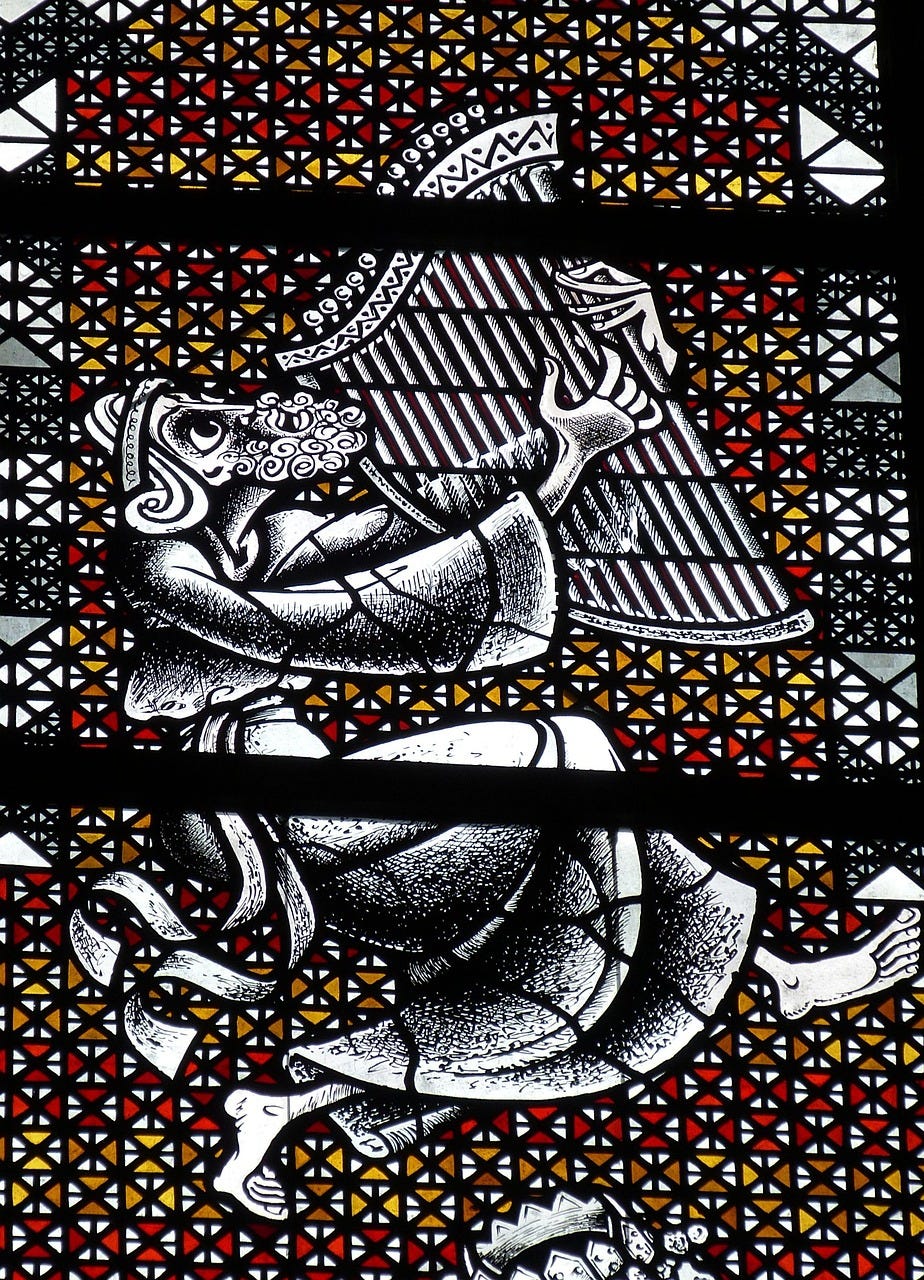
David wins Saul’s approval and is made harpist and armor-bearer for Saul. Do you remember the story of David and Goliath? That happened next. David 1, Goliath 0. David is praised by the people as the ultimate warrior, which makes Saul insanely jealous.
Tuesday of the Second Week in Ordinary Time
1 Samuel 16:1-13
Ephesians 1:17-18
Our first reading today is from 1 Samuel 16, and the players include Samuel (the book’s author), Saul, and David.
Samuel is remembered as a prophet, judge, and wise leader of Israel. You may recall that Samuel was called by the Lord at night three times as a young man, each time answering “Here I am, you called me” to Eli, the priest of Shiloh and one of the last Israelite Judges before the rule of kings in ancient Israel. The first two times, Eli sent Samuel back to bed. On the third time, Eli realized that the voice was the Lord’s, and advised Samuel to say “Speak, Lord, for Your servant hears.” The next time he was awakened, he answered the voice as instructed, and the Lord revealed himself to Samuel, describing his displeasure with the direction Eli and his sons had been taking the Israelites and informing Samuel that the end of their rule was near. Samuel repeated this to Eli, who understood the consequences.
Samuel grew up, and the LORD was with him, not permitting any word of his to go unfulfilled. Thus all Israel from Dan to Beer-sheba came to know that Samuel was a trustworthy prophet of the LORD. The LORD continued to appear at Shiloh, manifesting himself to Samuel at Shiloh through his word. Samuel’s word spread throughout Israel. [1 Samuel 3:19-21]
It was Samuel who under God’s direction later identified Saul as the first king of Israel. By the time we meet Samuel and Saul in today’s reading, the Lord has lost patience with Saul for his disobedience of God’s commandments to “utterly destroy” the Amalekites. Like Eli before him, there will be no dynasty. God had a different plan.
The LORD said to Samuel: How long will you grieve for Saul, whom I have rejected as king of Israel? Fill your horn with oil, and be on your way. I am sending you to Jesse of Bethlehem, for from among his sons I have decided on a king. [1 Samuel 16:1]
Jesse begins presenting his sons to Samuel. The first son looked like a good choice.
But the LORD said to Samuel: Do not judge from his appearance or from his lofty stature, because I have rejected him. God does not see as a mortal, who sees the appearance. The LORD looks into the heart. [1 Samuel 16:7]
Seven sons later, the LORD was not satisfied.
Then Samuel asked Jesse, “Are these all the sons you have?” Jesse replied, “There is still the youngest, but he is tending the sheep.” Samuel said to Jesse, “Send for him; we will not sit down to eat until he arrives here.” Jesse had the young man brought to them. He was ruddy, a youth with beautiful eyes, and good-looking. The LORD said: There—anoint him, for this is the one! Then Samuel, with the horn of oil in hand, anointed him in the midst of his brothers, and from that day on, the spirit of the LORD rushed upon David. Then Samuel set out for Ramah. [1 Samuel 16:11-13]
But wait, there’s more!
When King Saul needs someone to soothe his tormented spirit, he begins looking for a harpist. One of the servants spoke up: “I have observed that a son of Jesse of Bethlehem is a skillful harpist. He is also a brave warrior, an able speaker, and a handsome young man. The LORD is certainly with him.” [1 Samuel 16:18]
David wins Saul’s approval and is made harpist and armor-bearer for Saul. Do you remember the story of David and Goliath? That happened next. David 1, Goliath 0. David is praised by the people as the ultimate warrior, which makes Saul insanely jealous.
In the next several chapters, there is ongoing strife between Saul and David, and David is forced to go into hiding for fear of his life. David and his friends are about to meet in secret, but have no food. David went to Ahimelech, the priest of Nob, who at first was unsure about helping, out of fear of possible retribution by Saul. David asks:
“Now what do you have on hand? Give me five loaves, or whatever you can find.” But the priest replied to David, “I have no ordinary bread on hand, only holy bread; if the men have abstained from women, you may eat some of that.”
David answered the priest: “We have indeed stayed away from women. In the past whenever I went out on a campaign, all the young men were consecrated—even for an ordinary campaign. All the more so are they consecrated with their weapons today!” So the priest gave him holy bread, for no other bread was on hand except the showbread which had been removed from before the LORD and replaced by fresh bread when it was taken away. [1 Samuel 21:4-7]
The recipe and handling of the showbread are described in Leviticus 24:5-9. The priest, who provided bread to David, favored by the Lord to become the King of Israel, was doing God’s will, not man’s will. Saul ordered the death of 86 priests in Nob when he found out what happened. Many wars, skirmishes, and Old Testament chapters later, Saul dies, and David is anointed the second (and arguably the greatest) King of Israel.
Today’s reading from the second chapter of the Gospel of Mark is from the beginning of Jesus' public ministry. The story is so significant that it is also recorded with remarkable similarity in the Gospels of Matthew and Luke.
In Mark’s writing, we have:
As Jesus was passing through a field of grain on the sabbath, his disciples began to make a path while picking the heads of grain. At this the Pharisees said to him, “Look, why are they doing what is unlawful on the sabbath?” He said to them, “Have you never read what David did when he was in need and he and his companions were hungry? How he went into the house of God when Abiathar was high priest and ate the bread of offering that only the priests could lawfully eat, and shared it with his companions?”
Then he said to them,
“The sabbath was made for man, not man for the sabbath. That is why the Son of Man is lord even of the sabbath.” [Mark 2:22-28]
The reference to David and the bread was covered previously and would have been known to the Pharisees. This may have invited them to compare Jesus to David. But before they can wrap their thoughts around that, Jesus speaks with authority. “The sabbath was made for man, not man for the sabbath.”
In John 1:3, we find, “All things came to be through him, and without him nothing came to be.”
Therefore, the sabbath, the day of rest, was made for man, not the other way around. What might that mean? We should not be focusing on work, money, or other diversions, but on contemplation, rest, doing the Lord’s work, and allowing others to do the same.
Jesus finishes with “the Son of Man is lord even of the sabbath,” asserting two things: HE is the Son of Man, and HE will help us use our sabbath day, the gift made for us, to do the things that are good in the sight of God the Father.
Have a blessed week!