

By Ron Bruni
This week’s readings, from Jeremiah, Psalm 102, and two passages from Matthew, speak to people who are distressed, wounded, frightened, uncertain, or spiritually misdirected. In each case, God’s answer is not simply to remove the immediate problem. His deeper purpose is to restore the relationship, to bring His people back to Himself, back to trust, and back to hope.
Memorial of Saint John Vianney, Priest
Jeremiah 30:1-2, 12-15, 18-22
Psalm 102:16-18, 19-21, 29, 22-23
Matthew 14:22-36
Matthew 15:1-2, 10-14
Once again, we find ourselves on the Sea of Galilee with the disciples caught in a storm. Matthew, Mark, Luke, and John all recount dramatic encounters between Jesus and His frightened disciples on the water. The setting is familiar, but the lesson continues to develop. Each encounter reveals something more about who Jesus is and what it means to trust Him.
Living on the Gulf Coast, we understand the strange fascination of a storm. We do not merely observe it; we experience it. The darkening sky, the gathering wind, the flash of lightning, and the crack of thunder remind us that, despite all our technology and accomplishments, we remain small before the forces of creation.
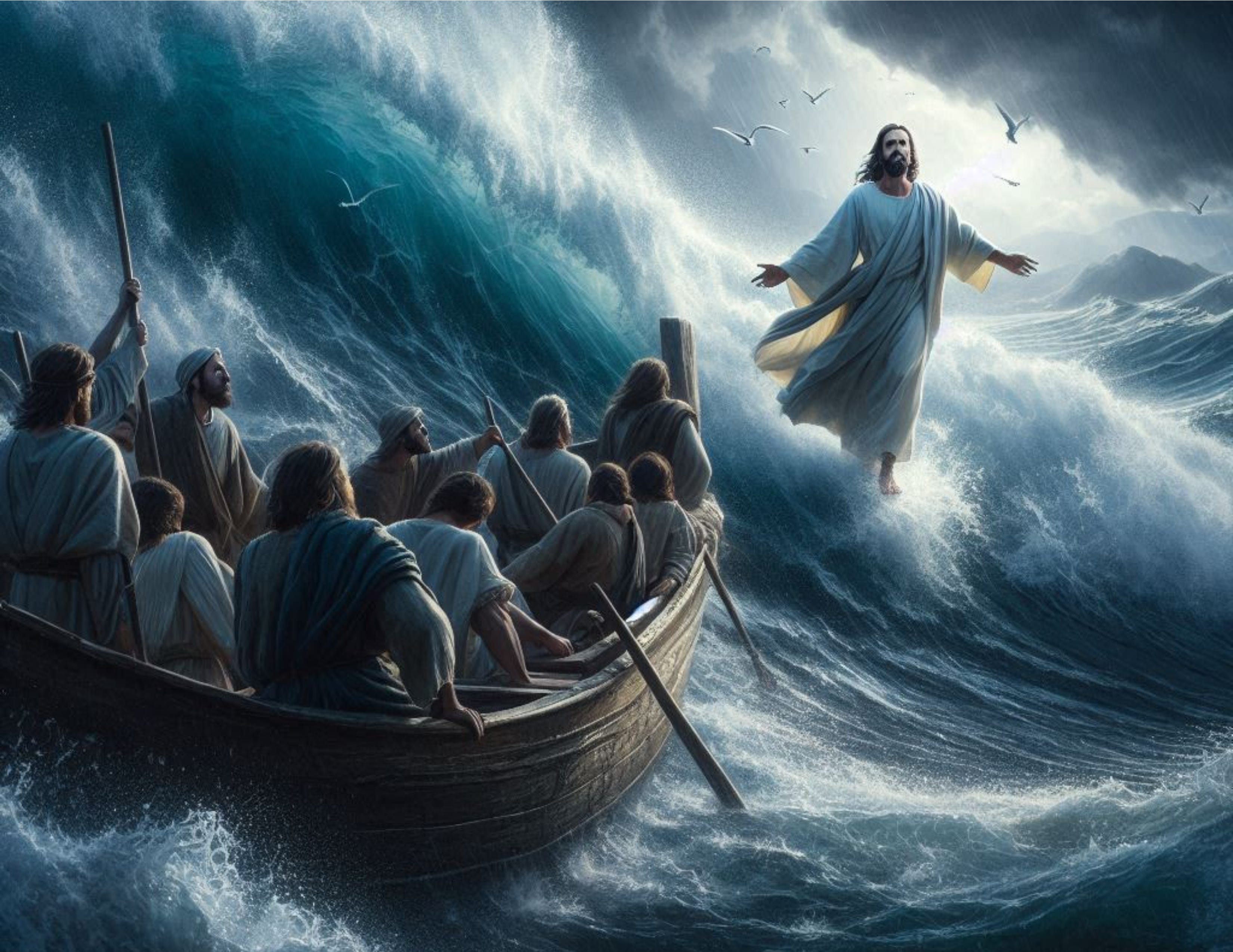
Perhaps that is why the Bible so often places its greatest lessons in the midst of storms. Storms have a way of blowing away our illusions of self-sufficiency until one essential question remains: Do I trust the One who is with me in the storm?
Matthew includes two major storm narratives, and they portray two successive stages in the disciples’ spiritual development.
In the first, Matthew 8:23–27, Jesus is in the boat with His disciples. A violent storm arises, but Jesus is asleep. The disciples awaken Him in panic, and He commands the wind and sea to be still. The story concludes with their question: “What sort of man is this, that even the winds and the sea obey him?”
The miracle is not primarily about the weather. It is about the identity of Jesus. Throughout the Old Testament, it is God who commands the waters and brings order out of chaos. Matthew is quietly leading us toward the recognition that the divine authority of God is present in Christ.
The second storm, in Matthew 14:22–33, carries the revelation further. This time, Jesus is not visibly with the disciples when the storm begins. He has sent them ahead while He withdraws to pray. They struggle against the wind until Jesus comes toward them, walking upon the water.
Matthew then adds something not found in the other Gospel accounts: Peter steps out of the boat. For a moment, with his eyes fixed upon Jesus, Peter walks toward Him. But when his attention shifts from Christ to the wind and waves, he begins to sink.
Peter cries out, “Lord, save me,” and Jesus immediately reaches out His hand.
The conclusion is different from that of the first storm. The disciples no longer ask, “Who is this?” Instead, they worship Him and confess: “Truly, you are the Son of God.”
The question raised in the first storm has been answered.
The first account reveals Christ’s power. The second shows what faith in that power requires. Faith is not merely believing that Jesus can calm a storm. It is trusting Him enough to move toward Him while the storm is still raging.
The disciples have progressed from astonishment to confession, from watching a miracle to participating in one, and from fear to worship.
The Gospel writers tell these stories with somewhat different emphases. Matthew stresses the identity of Jesus and leads his readers toward the confession that He is the Son of God. Mark, drawing upon the preaching and memories associated with Peter, preserves the disciples’ painfully human question: “Teacher, do you not care that we are perishing?” His account speaks powerfully to those who must continue trusting when Christ appears silent.
Luke, the companion of Paul and evangelist to the wider Gentile world, emphasizes that Christ’s authority reaches every dimension of human need. No disorder in creation and no crisis in human life lies beyond His power.
The same storm therefore becomes several related proclamations: Matthew reveals who Jesus is; Mark asks whether we can trust Him when we are afraid; and Luke proclaims that no force of chaos lies beyond Christ’s saving authority.
Jeremiah speaks to people facing another kind of storm. Their nation is broken, their future uncertain, and their wound is described as “incurable.” Yet destruction is not God’s final word. God promises: “I will restore your fortunes.”
The Lord sees not only the suffering of the present moment but also the restoration that His people cannot yet imagine.
Peter experiences this personally. While his attention remains upon Christ, he does what should be impossible. But when he begins measuring the wind, calculating the danger, and considering his own helplessness, he sinks.
Peter’s mistake is often our own. We begin with our eyes upon Christ, but gradually our attention moves elsewhere, to a diagnosis, family difficulties, financial concerns, disturbing headlines, or an uncertain future. Soon, the troubles occupying our minds appear larger than the Christ standing before us.
In the second Gospel passage, the Pharisees are preoccupied with ritual handwashing and inherited religious customs. Jesus tells them that they are concentrating on the wrong thing. The deepest human problem is not external but internal.
The most dangerous storms are not always outside our windows. Some arise within the heart: fear, pride, resentment, anxiety, the desire to control everything, and the belief that if we organize life perfectly, we can somehow make ourselves safe.
Psalm 102 holds these readings together with a simple assurance: “The Lord looked down from his holy height.”
This is not the distant gaze of a God who merely observes human suffering. It is the compassionate attention of the Father who hears “the groaning of the prisoners” and comes to release those who feel trapped by fear, suffering, sin, or uncertainty.
God sees the wounded nation of Jeremiah. He sees the disciples straining against the wind. He sees Peter sinking. He even sees through the outward religiosity of the Pharisees to the disorder within their hearts. And He sees us in whatever difficulty we may be facing.
The Psalm does not end in distress. It ends with God’s people gathered together in worship. Matthew’s second storm ends in exactly the same way. The disciples begin the night struggling in fear, but after Jesus enters the boat, they worship Him.
The storm has not merely been survived. Their understanding of Christ has been transformed.
That is the message these readings offer us. We naturally pray that our difficulties will pass, and often they do. The rain stops, the warning ends, the diagnosis improves, or the crisis is resolved. But Christian faith is more than confidence that God will give us favorable circumstances.
It is the conviction that whether the sea is calm or raging, Christ remains Lord.
The presence of a storm does not mean the absence of God. Sometimes it is amid the wind and waves that we see Christ most clearly and discover what we truly believe.
And it is there, above the noise of the storm, that we hear His voice: “Take courage. It is I. Do not be afraid.”