


The great event of all history is that moment when Jesus allowed his own death on the cross. His death and subsequent resurrection constitute the event that institutes the Eucharist and ushers in the final stage of salvation history, the Church.
Tuesday after Epiphany
I John 4:7-10
Mark 6:34-44
In researching the first reading from St. John, I came across some interesting concepts and teachings about the “God is love” or “love is of God” statements. For example, Robert Candlish tells us, “Love is of God.” This does not mean that God is the Author or Creator of love. All created things are of God, but love is not a created thing; it is a Divine property, a Divine affection (R. S. Candlish, Lectures on First John - 1869).
In the Catechism, paragraph 221, “God’s very being is love. By sending his only Son and the Spirit of Love in the fullness of time, God has revealed His innermost secret. God himself is an eternal exchange of love, Father, Son, and Holy Spirit, and he has destined us to share in that exchange.”
St Augustine explains, “even if nothing more were to be said in all the pages of Sacred Scripture, and all we heard from the mouth of the Holy Spirit were that “God is Love” there would be nothing else we would need to look for.”
St Jerome hands down a tradition concerning the last years of St John’s life: when he was already a very old man, he used to always say the same thing to the faithful: “My children, love one another!” On one occasion, he was asked why he insisted on this, to which he replied with these words worthy of St John: “Because it is the Lord’s commandment, and if you keep just this commandment, it will suffice.”
What a great compliment to our Gospel, “When Jesus saw the vast crowd, his heart was moved with pity for them, for they were like sheep without a shepherd; and he began to teach them many things.” I wish we had a copy of His sermon! We don’t, but here it speaks of Jesus’ love and compassion for the people who gathered to hear Him, and in the following verses, His actions speak volumes.
Jesus knows the people are hungry, that they need food. But He also knows they are hungry for spiritual nourishment. This miracle performed by Jesus is just one of many prefigurements of our Holy Eucharist Sacrament. This multiplication of the loaves and fishes starts with the offering available: five loaves and two fish. Jesus, “looking up to heaven, said the blessing, broke the loaves, and fed everyone there till they were satisfied.”
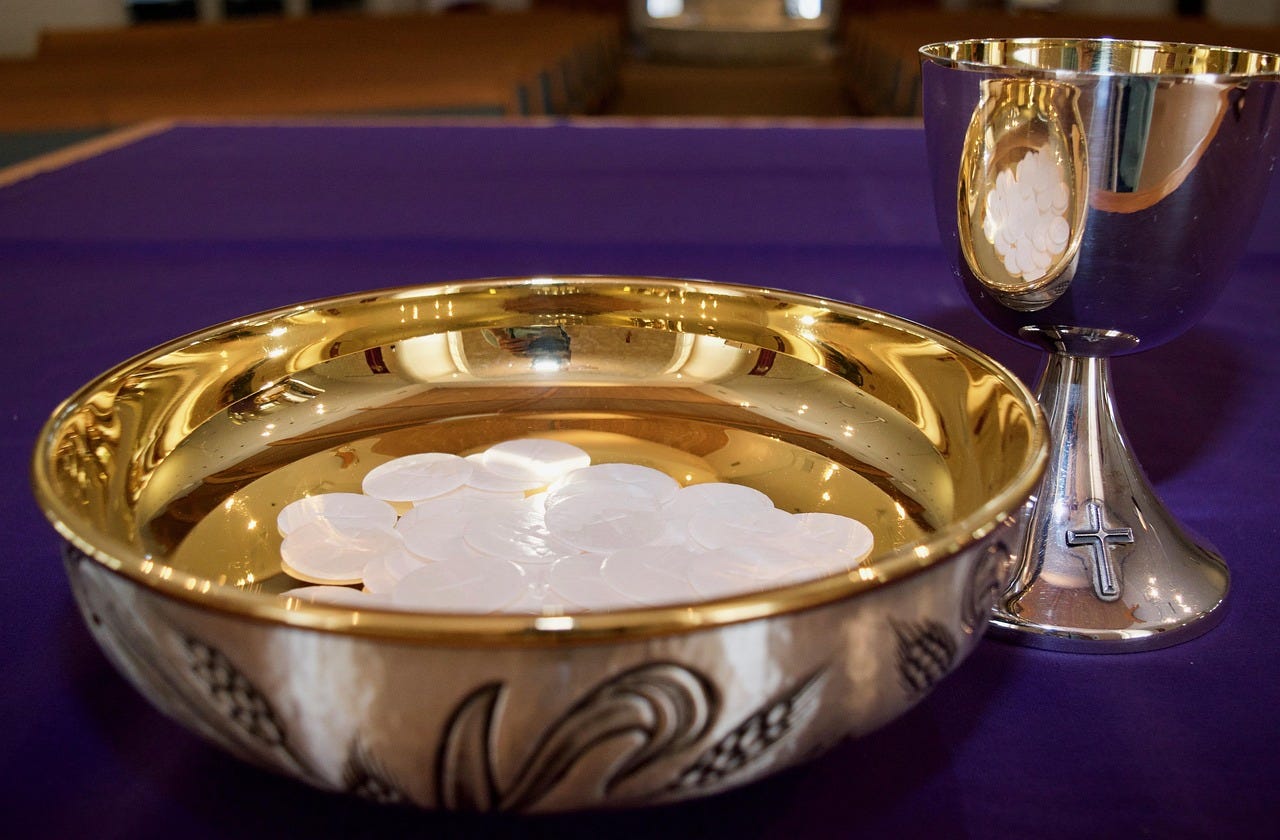
Just experiencing this action, the people were fed spiritually; this was holy food, but only a foreshadowing of what was to come. I want to share with you a reflection from Raniero Cantalamessa’s book The Eucharist, Our Sanctification, he starts out “the entire Old Testament was a preparation for the Lord’s Supper” (p. 6).
The first of the prefigurements was Melchizedek in Gn 14:18-20. St. Paul declares that Jesus is “a high priest forever after the order of Melchizedek” (Heb. 6:20) who, in offering bread and wine, is clearly a prefigurement of Christ (Heb. 7:1 ff; Ps. 110:4; Gen. 14:18).
John’s Gospel (6:31) makes the connection between the Eucharist and the manna Yahweh sent to feed the Israelites in the desert (Ex. 16:4 ff), but it is Jesus who shows that the manna is a mere foreshadowing of the “true bread from heaven” (Jn. 6:32–33).
The greatest Old Testament prefigurement of the Eucharist is the Passover (Ex. 12:23). That night, when God smote all the first-born of the Egyptians, he spared the first-born of Israel. Why? “The blood shall be a sign for you upon the houses where you are; and when I see the blood I will pass over you, and no plague shall fall upon you to destroy you” (Ex. 12:13). But was it the blood of the Passover lamb alone, into which a hyssop was dipped to sprinkle blood on their doorposts, that saved the Israelites? No. It foreshadowed the blood of the Lamb of God—the Eucharist.
When Jesus, like other observant Jews, celebrated the Passover, it took place in two phases and in two different places. The first was the slaying of the lamb, which took place in the temple. The second was the eating of the lamb during the Passover supper, which took place in the home or in some other suitable place outside of the temple. This meal was a memorial not only of the Passover and the exodus from Egypt but also of all God’s merciful interventions in the history of Israel. Cantalamessa tells us the Passover celebrated four great events: the creation of the world, the offering of Isaac, the exodus out of Egypt, and the coming of the Messiah (p. 7).
The memorial of the Passover looked forward, as a prefigurement, to mankind’s exodus from the slavery of sin. We are left with a sense of wonder and awe as we contemplate the Mediator of the New Covenant holding the unleavened bread in His sacred hands and saying: “This is my body which is given for you. Do this in remembrance of me” (Lk. 22:19). The tragic irony was that, after centuries of longing for the Messiah’s coming, the Jewish authorities crucified him during the Passover feast. Their closed minds and hard hearts made them unwilling to recognize that on Calvary they sacrificed the true Lamb of God (Jn. 1:29, 36; Rev. 5:6).
Jesus’ use of the words “remembrance” and “New Covenant” (Lk 22:19–20) would remain forever fixed in the minds of the apostles, reminding them that in instituting a new Passover, Jesus was perfectly fulfilling the old Passover. The world had arrived at the “fullness of time” (Eph. 1:10) in which the sacrificing of unblemished lambs was replaced once and for all by “Christ our Pascal Lamb has been sacrificed” (I Cor. 5:7).
The four evangelists describe in complementary ways the event that brought the new Passover, the Eucharist, into existence. The beloved disciple John interweaves throughout his gospel the Passover theme (1:29, 36; 2:13, 23; 6:4; 11:55; 12:1; 13:1; 18:28, 39; 19:14). In unfolding Jesus’ first miracle John develops the Eucharistic motif he introduced from the lips of John the Baptist: “Behold, the Lamb of God!” (1:29, 36). The same Jesus who, by a miracle, changes water into wine will, by a deeper miracle, change wine into His own blood.
The miracle of the multiplication of the loaves, which we read from Mark’s Gospel this morning, St John recounts in his Gospel starting at chapter 6, verse 4. John also employs the Passover motif prior to introducing Jesus’ bread of life discourse (Jn 6:26–71).
It is John who confirms that Jesus died on the cross at the precise hour that his Old Testament type, the Passover lambs, were being slain in the temple (19:14). In the Passover liturgy God instructs the Jews not to break a bone of the sacrificial lamb (Ex. 12:46); it is John who makes the connection with that rite and Jesus’ death on the cross: “For these things took place that the scripture might be fulfilled, ‘Not a bone of him shall be broken’” (19:36).
Here John is quoting Exodus 12:46, Numbers 9:12, and Psalm 34:20. And it is John’s alone of the four gospels that touches on the Passover significance of the hyssop: “Jesus, knowing that now was time to complete the [Last Supper] Passover meal, He said, ‘I thirst.’ A bowl full of sour wine stood there; so they put a sponge full of the sour wine on hyssop and held it to his mouth, (which is the 4th cup, from the Passover meal, the cup of Consummation). When Jesus had received the sour wine, he said, ‘It is finished,’ and he bowed his head and gave up his spirit” (19:28–30).
Matthew, Mark, and Luke focus on the other part of the Passover ritual, the Last Supper. They elaborate that the Eucharist is the transformation of the old Passover to the new. They understand that the Eucharistic consecration already contains the event of Christ’s death on the cross, just as future Eucharistic celebrations are inseparably linked to that same event. Jesus’ words and actions are literally creative—that is, they produce what they signify.
Thus in the consecration at the Last Supper and in the breaking of the bread, which became synonymous with the consecration of the Eucharist (Lk. 24:35), we have the supreme and prophetic action that restores mankind in a New Covenant (Lk 22:20; 1 Cor 11:25; 2 Cor 3:6; Heb 8:8, 13; 12:24). The words of consecration constitute the moment of the mystical sacrifice of Christ which “is in remembrance of” Jesus’ real sacrifice on the cross.
The great event of all history is that moment when Jesus allowed his own death on the cross. His death and subsequent resurrection constitute the event that institutes the Eucharist and ushers in the final stage of salvation history, the Church.
And so we come to the time in which we live. The Eucharist is present to us sacramentally. As a sacrament it is in the bread and wine, changed to His Body and Blood the action instituted by Christ at the Passover supper with the words: “This is my body which is given for you. Do this in remembrance of me. . . This cup which is poured out for you is the New Covenant in my blood” (Lk. 22:19–20; 1 Cor. 11:24–25).
We consummate the New Covenant when we consume the Eucharist, the Body and Blood of the Lamb of God, as Jesus instructed in John’s Gospel, “Amen, Amen, I say to you, unless you eat the flesh of the Son of Man and drink His blood you do not have life within you. Whoever eats my flesh and drinks my blood has eternal life, and I will raise him on the last day” (Jn 6:53-54)
The difference between Christ’s death on the cross (the event) and the Eucharist (the sacrament) is the difference between history and liturgy. The historical event happened once and will never be repeated (Heb. 9:25–26). The liturgical sacrament, however, not only keeps the past from being forgotten; through it, the Eucharist of history—Jesus’ passion and death—is realized at every Mass.
Jesus’ sacrifice on the cross is concluded as an event, but through the Holy Spirit it continues sacramentally in time and mystically in eternity. This insight provides the key to understanding John’s heavenly vision of the resurrected Jesus, who appeared as “a Lamb standing as if it had been slaughtered” (Rev. 5:6). While his act of physical death will never be repeated, Jesus’ act of total self-giving to the Father for us (Rom. 8:32) continues eternally in Love—that is, the Holy Spirit.
To me, this is the “Greatest Miracle” God has blessed mankind with through His Son and the Holy Spirit! We weren’t present when Jesus turned water into wine or when He turned bread and wine into His own Body and Blood at the Last Supper, but we have been present many times since when he turns bread and wine into His own Body and Blood at every Mass, in the hands of the Priest acting in “Persona Christi”.
I want to share a prayer I recite at the Consecration:
When the priest raises the Body: Jesus, You are the Lamb of God, You are the Bread of Life, Thank You, my Lord and my God, for this Holy Food.
And when he raises the Cup: Jesus, You shed Your Precious Blood to wash away my sins and to provide this Holy Drink, Thank You, my Lord and My God, for this Holy Meal.