


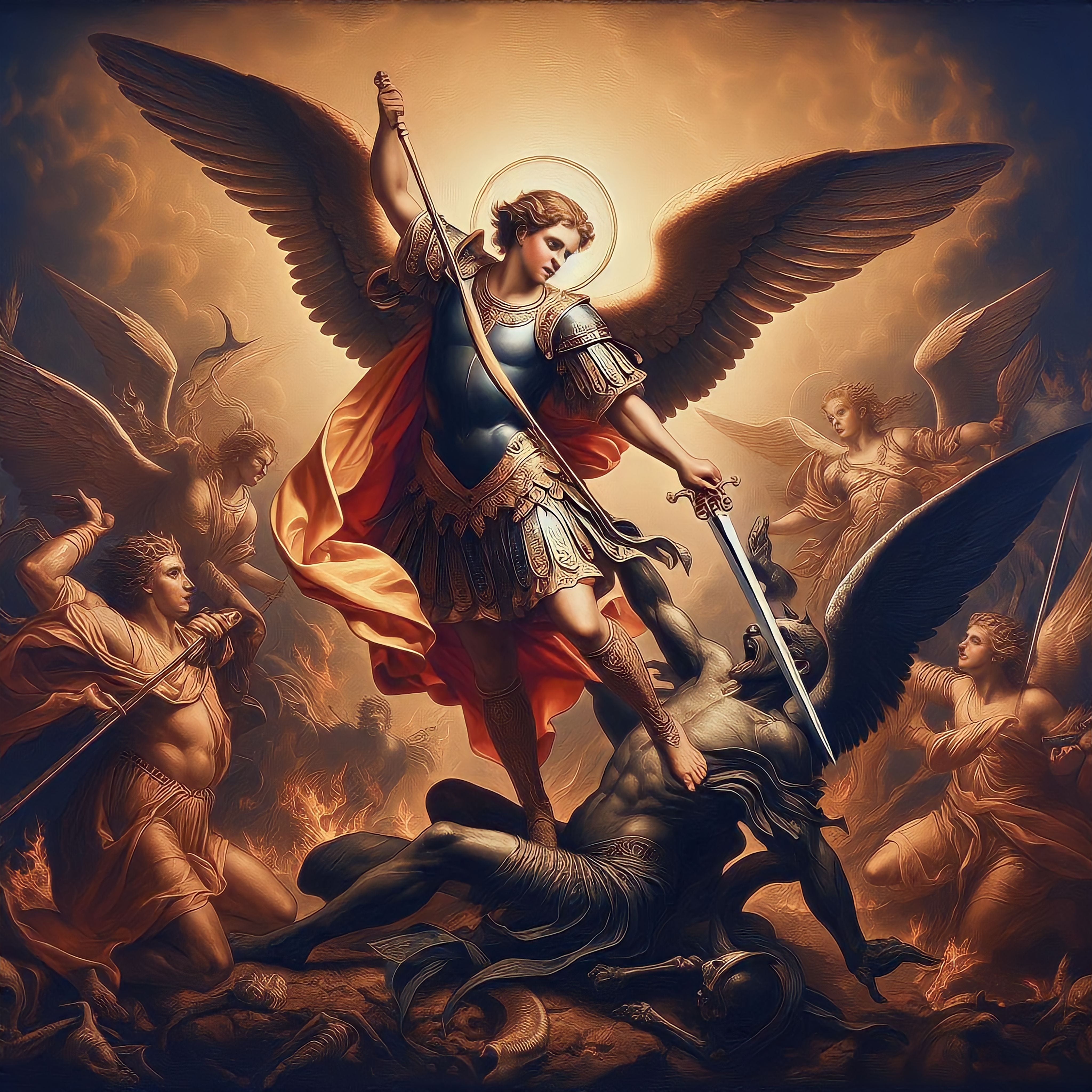
Unlike how Satan and God are portrayed in movies, books, and cartoons, Satan and God are not equally powerful enemies warring with one another. On the contrary, Ezekiel 28 tells us the end of the story has already been decided. God, in His sovereignty, has already appointed for Satan, the King of Tyre, to come to a horrible end and to be no more.
Tuesday of the Twentieth Week in Ordinary Time
Ezekiel 28:1-10
Deuteronomy 32:26-27ab, 27cd-28, 30, 35cd-36ab
Matthew 19:23-30
Who is the Prince of Tyre? A King? An angel? Or Satan?
As I began researching today’s Reading from Ezekiel, I quickly found that the blasphemous things the prince of Tyre is described as saying and doing have long been understood in the Christian tradition as reflecting the mind and disposition of Satan. I found a reflection by Rachael Schmoyer that I want to read that does a great job of explaining:
“Who is the King of Tyre? (Chapter 28 of Ezekiel.)
I love reading a book or watching a movie that presents a compelling backstory. Remember the television show Lost? Or the new movie of Little Women with its flashback storytelling? Ezekiel 28 tells Satan's backstory in poetic flashback form (with a little flash-forward, too) through God’s message of lament for the King of Tyre.
The Background of Ezekiel’s Message
Ezekiel is forced into exile from Jerusalem to the land of Babylon just as he was preparing to become a priest. One day, while he was sitting by the canal, God appoints him as a prophet, a watchman over the house of Israel. The first section of the book of Ezekiel gives messages of judgment to God’s people. Then, there is a section of judgment for the nations that geographically surround the land of Israel. Several chapters are spent judging and lamenting over the nation of Tyre including a portion of chapter 28 which laments the King of Tyre.
The King of Tyre is actually referring to Satan. Whenever I would study about Satan or see a cross-reference to Ezekiel 28 and would read these verses, they never really made sense to me. But I recently Bible-journaled my way through the entire book of Ezekiel, and now it finally makes sense. The King of Tyre is Satan!
The Use of Prince and King in Ezekiel
In Ezekiel 19, Ezekiel refers to the last four kings of Israel as “princes” of Israel. Why? Because God wants to emphasize that He is Israel's true King. (Some translations may use the word ruler instead of prince, but the idea is the same.) Ezekiel uses this literary construct (referring to kings as princes) several times in the book. In Ezekiel 28, Ezekiel first mentions the prince of Tyre (who is actually the King) and then mentions the King of Tyre who is the power behind the prince. This analogy of prince/king relationships is what really made it click for me, pointing to the King of Tyre as Satan. This is something you don’t notice if you read Ezekiel 28 without reading the rest of Ezekiel.
The Garden of Eden
The King of Tyre is said to have been in the Garden of Eden (Ezekiel 28:13: “You were in Eden. The garden of God”). The actual reigning king of Tyre could not have been in the Garden of Eden. Yes, this section is poetic, but the details in the description and the story paint a picture of the actual Garden of Eden.
The King of Tyre was Created Perfect
All humans since Adam and Eve have been born into sin and are sinners (Romans 3:23, “all have sinned and are deprived of the glory of God”). Therefore, God would not have said that the human ruler of Tyre in Ezekiel’s day was created perfect (Ezekiel 28:15, “You were blameless in your ways from the day you were created”). Plus, God rested from creation after the sixth day, so I do not think He would use the word “create” to describe how each human on the earth has been brought into being. So the King of Tyre in Ezekiel 28 cannot be a human who was born after Adam and Eve.
The King of Tyre was a Guardian Cherub
In fact, the King of Tyre is not described as human at all. He is described as a guardian cherub, an angelic being (Ezekiel 28:14, “With the Cherub I placed you: you were on the holy mountain of God”). Because of his pride, he was thrown down from the mountain of God to the earth. But unlike how Satan and God are portrayed in movies, books, and cartoons, Satan and God are not equally powerful enemies warring with one another.
On the contrary, Ezekiel 28 tells us the end of the story has already been decided. God, in His sovereignty, has already appointed for Satan, the King of Tire, to come to a horrible end and to be no more (Ezekiel 28:19, “you have come to a dreadful end and shall be no more for ever”). That has not happened yet. We read more about Satan's final end in Revelation 20.
Why Do We Need Satan’s Backstory?
Once I saw that the King of Tyre is Satan’s backstory, then I wondered why God bothered to give us this information about Satan. What purpose in there in knowing His backstory? I think there are a couple of reasons:
• We need to know Satan is a created being and not an evil godlike equivalent. In the backstory, we are clearly told that he was created. He is not eternal like God is. He is not omnipotent or omniscient. He doesn’t have any qualities reserved only for God.
• We need to know that God is in control. In Ezekiel, God makes it clear that He is the LORD. In fact, that is what God says over and over again in the book of Ezekiel about why He is doing something: “so that they will know that I am the LORD.” Sharing Satan’s backstory fits with this theme of Ezekiel. When we know where Satan came from and where he is going, we know that God is the LORD. God is in control of Satan from start to finish.
• So we know what Satan is all about. He was motivated by pride because of his beauty before he was thrown from the mount of God. He is still motivated by pride in wanting for himself what is rightfully God’s. Knowing about Satan’s pride helps us stay away from pride in our own lives through the power of the Holy Spirit.
• We are curious! When you read Genesis for the first time, did you wonder, “Where did that serpent come from?” Well, once you read Ezekiel 28, now you know.
For me, it was when I read Rachael’s Reflection on Ezekiel 28.
Next, our Responsorial Psalm is from the Song of Moses in Deuteronomy 32. In poetic form, it reminds us of God’s faithfulness, Israel’s unfaithfulness, and the consequences of rebellion, emphasizing the importance of remaining true to God. The Song of Moses is delivered by Moses shortly before his death and the Israelites’ entry into the Promised Land. It reminds the people of their Covenant with God and warns them of the consequences of breaking it.
Today’s Gospel reading follows immediately after the story of the Young Rich Man, when he was instructed by Jesus to “go sell what you possess and give it to the poor, and you will have treasure in heaven; and come follow me. When the young man heard this, he went away sorrowful; for he had great possessions.”
Jesus begins today’s parable with a stunning declaration: “It will be hard for a rich person to enter the kingdom of heaven” (Matt. 19:23). The metaphor of a camel passing through the eye of a needle is used to illustrate the possession of wealth as a barrier to attaining eternal life in God’s Kingdom. Wealth can become an idol, enslaving us to materialism, false security, and the need to justify actions to keep or gain more. It can distract us from God, making Him secondary to possessions, relationships, and status.
The disciples’ reaction, “Who then can be saved?” is answered by Jesus, “For men this is impossible, but for God all things are possible” (Matt. 19:26). This affirms that while human effort alone cannot overcome the desire for wealth, God’s grace can transform hearts and priorities.
My take from today’s readings is to always place your trust in God. As we pray in the Divine Mercy Chaplet, “Jesus, I place my trust in You.”