

By Tim Trainor
“He shows the manner of the passion when He, Jesus, says, so must the Son of Man be lifted up: and this refers to the lifting up of Him on the cross. So when it says, The Son of Man must be lifted up, it also says this to indicate the manner of his death.”
Tuesday of the Fourth Week in Ordinary Time
Numbers 21:4-9
John 8:21-30
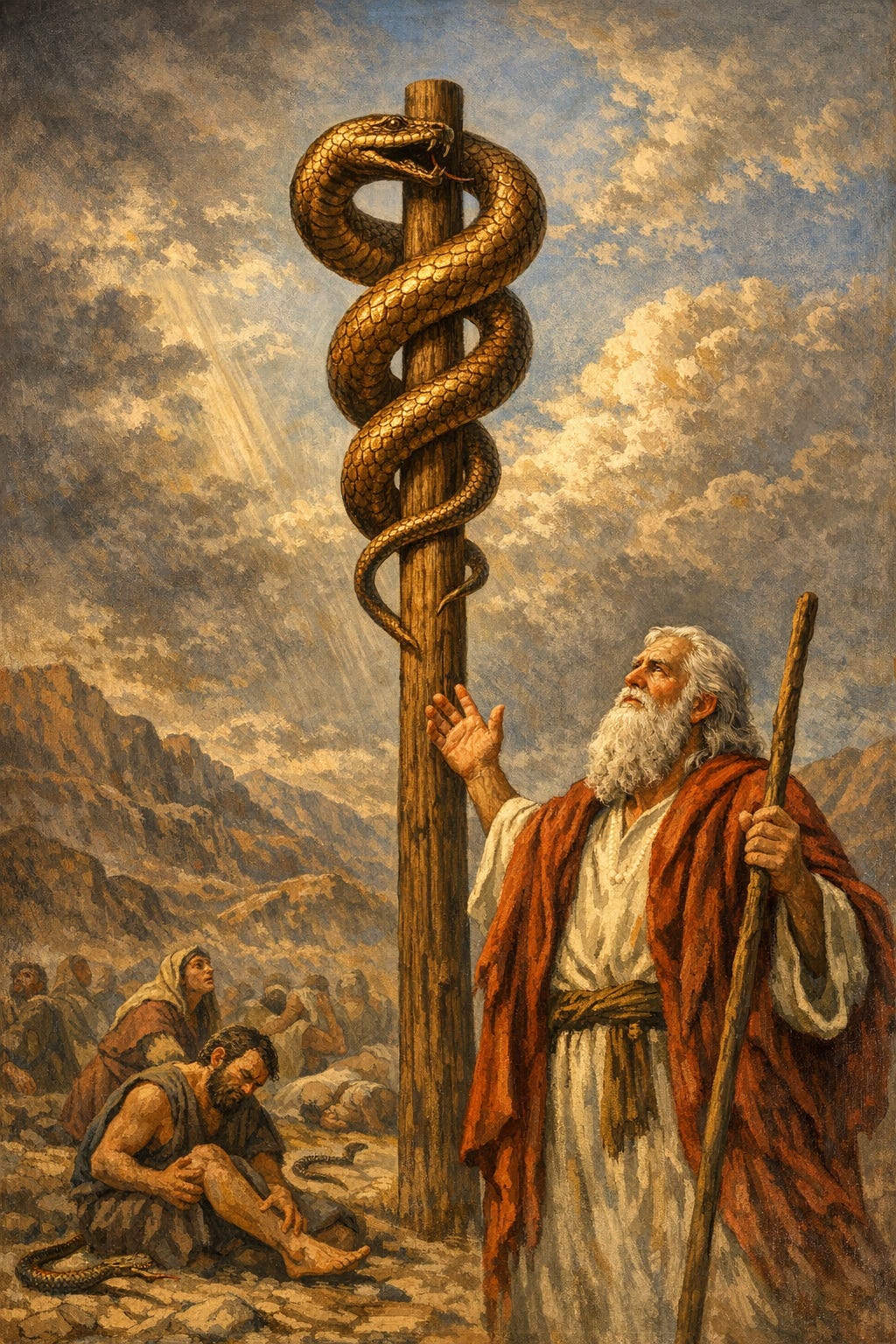
Saint Thomas Aquinas, in his Commentary on the Gospel of St. John, picks up on some subtle yet very relevant details mentioned in our first reading from Numbers 21 about the Bronze Serpent, which I wish to explore with you this morning. In this Commentary, he cites 3 instances in which Jesus refers to Himself as being ‘lifted up’ in fulfillment of this Old Testament event via typological analogy.
By way of review: Typology in religion is a method of biblical interpretation where persons, events, or institutions (types) in the Old Testament are viewed as divinely intended patterns that foreshadow or prefigure greater realities (anti-types) in the New Testament, specifically centered on Jesus Christ or the Church. It links the two testaments, viewing Old Testament history as a “shadow” of the New Testament’s “realities.”
Aquinas’ first citation of this ‘lifting up’ type of event, and the most detailed one, occurs when he examines John 3:14. He states: “[Jesus] takes the symbol from the old law (the serpent), in order to adapt it to help Nicodemus understand what Jesus ’ mission was. He, Jesus, says, Just as Moses lifted up the serpent in the desert…” This refers to Numbers (21:5) when the Lord God, faced with the Jewish people saying, “We are sick of this useless food, sent serpents to punish them; and when the people came to Moses and he interceded with the Lord who then commanded that for a remedy, they make a serpent of bronze; and this was to serve both as a remedy against those serpents - and - as a symbol of the Lord’s passion.” He, God saw, per Aquinas, this ‘temporal’ [or in my own words ‘temporary’] punishment – the sending of serpents, was designed to correct their wayward behavior and re-orient them, and centuries later us, by example, back towards God!
As you may recall, Saint Thomas Aquinas lived from 1225 to 1274 and was an Italian Dominican friar, philosopher, and theologian known as the “Angelic Doctor,” who famously synthesized Aristotelian philosophy with Christian theology. As a major scholastic thinker, he argued that faith and reason are complementary, notably in his masterwork, Summa Theologica.
With that as an introduction, here are the details of Aquinas’ logic, plus some of my own much poorer offerings, which I would like us to explore this morning.
I believe that much of Aquinas’ first ‘lifting up’ citation’s discussion and teaching points used early on in his John 3:14 comments apply equally to our John chapter 8 reading this morning. So let’s start by taking a close look at what Aquinas has to say about Jesus’ nighttime meeting with Nicodemus in John 3:14 and His first use of the ‘lifted up’ symbol in His conversation to help Nicodemus understand His mission.
Aquinas begins: “Just as Moses lifted up the serpent in the desert, referring to Numbers (21:5), when the Lord, faced with the Jewish people who were saying, We are sick of this useless food, and He, God, sent serpents to punish them; and the people subsequently came to Moses asking him to intercede with the Lord. The Lord commanded that, for a remedy, they make a serpent of bronze; and this was to serve both as a remedy against those serpents and as a symbol of the Lord’s passion [Aquinas’ word, but mine is: anger]! Hence [Aquinas says] it, [this bronze serpent] was lifted up as a sign (see NM 21:9).”
He goes on: “Now it is characteristic of serpents that they are poisonous, but not so the serpent ‘of bronze’, although it was a symbol of a poisonous serpent. So, too, Christ did not have sin, which is also a poison: Sin, when it is fully developed, brings forth deaths (As 1:15) but Jesus had only the likeness of sin as it says: God sent his own Son, in the likeness of sinful flesh (Rom 8:3). And thus Christ had the effect of the serpent against this insurgence of inflamed concupiscences.”
How about that phrase from Aquinas to describe/give us a word picture of mankind’s ever-present sin problem: Insurgence of inflamed concupiscences! What a mouthful of descriptive 13th-century talk!
But don’t let his language cause you to miss the very important point Aquinas makes here: Jesus is the permanent/eternal solution to our sin problem!
Aquinas continues on: “He shows the manner of the passion when He, Jesus, says, so must the Son of Man be lifted up: and this refers to the lifting up of Him on the cross. So when it says, The Son of Man must be lifted up, it also says this to indicate the manner of his death.”
He willed to die lifted up, first of all, to cleanse the heavens: for since he had [please note: the past tense here] cleansed the things on earth by the sanctity of his life, the things of the air were left to be [future tense] cleansed by His death: through Him He should reconcile all things to Himself, whether on earth or in the heavens, making peace through His blood (Col 1:20). Secondly, to triumph over the demons who prepare for war in the air: the prince of the power of the air (Mph 2:2). Thirdly, He wished to die lifted up to draw our hearts to Himself: [Because] if I am lifted up from the earth, [I]will draw all to myself. (John 12:32, from our reading)
And fourthly, because in the death of the cross He was lifted up in the sense that there He triumphed over his enemies; so it is not called a death, but ‘a lifting up’: He will drink from the stream on the way, therefore He will lift up His head (quoting from PS 109:7).
Fifthly, He willed to die lifted up because the cross was the reason for His being lifted up, i.e., exalted: He became obedient to the Father even to death, the death of the cross; on account of which God has exalted him (per Phil 2:8).
Now, Aquinas reasons, the fruit of Christ’s passion is eternal life; hence He [Jesus] says, so that everyone who believes in Him, [by] performing good works, may not be lost, but have eternal life. And this fruit corresponds to the fruit of the symbolic serpent. For whoever looked upon the serpent of bronze was freed from poison, and his life was preserved. But, [in contrast] he who looks upon the lifted up Son of Man, and believes in the crucified Christ, he is freed from poison and sin: “Whoever believes in Me will never die”, and is preserved for eternal life. But these things have been written so that you may believe that Jesus is the Christ, the Son of God, and so that believing, you may have [eternal] life in His name (John 20:31).”
All the foregoing quoted text was said by Saint Thomas Aquinas!
Lastly, I noticed that the Communion Antiphon for today’s Mass is from John 12:32: When I am lifted from earth, I will draw all to Myself, says the Lord.
This scripture quote is the last of the 3 of Aquinas’ ‘lifted up’ citations in his Commentary. Coincidence that it is used in today’s Mass? I think not!
In closing, I believe that Saint Thomas Aquinas, this morning, is advising each of us to draw from our 3 Mass readings this morning the ability to see any and all the Temporal or temporary Punishments — the sending of ‘serpents’, for example into our lives — that we experience as something designed to correct our wayward behavior and re-orient us back towards God.
Eternal punishment, however, is something quite different. It is something that we choose when we remain in a state of sin until death.
Fortunately, for us, Christ has removed the eternal penalty if only we turn to Him and have faith in everything that He has delivered to us through His teachings, per Mark 10:52.
In closing, per Aquinas: Jesus, the God-man, is “Our Eternal Solution” because: If Jesus were only just another man alone, He could not have bridged the infinite, sin-caused chasm between God and man.
Therefore, if He were only the spiritual God, Aquinas reasons, He would not have been able to give us the physical example of selfless love to the point of bodily death.
But by being both God and man, Jesus made God immediately available to us and gave us a living, breathing, physical example of how to live and love!
So, the next time you look at a crucifix (especially during this Easter), reflect on the lengths that Jesus was willing to go out of love for each of us and that Jesus allowed Himself to be killed in order to give each of us the ability to live forever with Him!
Thus, the serpent on the pole was only a temporary fix for a temporary problem.
Whereas, Jesus Christ lifted up in crucifixion is the eternal fix for our otherwise inescapable sin problem. Or, as Saint Thomas Aquinas would say it, Jesus Christ is our eternal: ‘Insurgence of inflamed concupiscences’ solution!