


By Steve Hall
In the Book of Acts, we hear that a ‘great number’ or a ‘large number’ came to believe. The incident piqued my curiosity — not because people scattered in the face of persecution, nor because their message was received, but because it made me wonder what they actually said to those they met. Acts tells us in nonspecific terms that they were “preaching the word.” The details are not listed. So, what were they preaching?
Tuesday of the Fourth Week of Easter
Acts 11:19-26
John 10:22-30
“Those who had been scattered by the persecution that arose because of Stephen went as far as Phoenicia, Cyprus, and Antioch, preaching the word to no one but Jews. There were some Cypriots and Cyrenians among them, however, who came to Antioch and began to speak to the Greeks as well.”
Later in this passage, we hear that a ‘great number’ or a ‘large number’ came to believe. The incident piqued my curiosity — not because people scattered in the face of persecution, nor because their message was received, but because it made me wonder what they actually said to those they met.
Acts tells us in nonspecific terms that they were “preaching the word.” The details are not listed. So, what were they preaching?
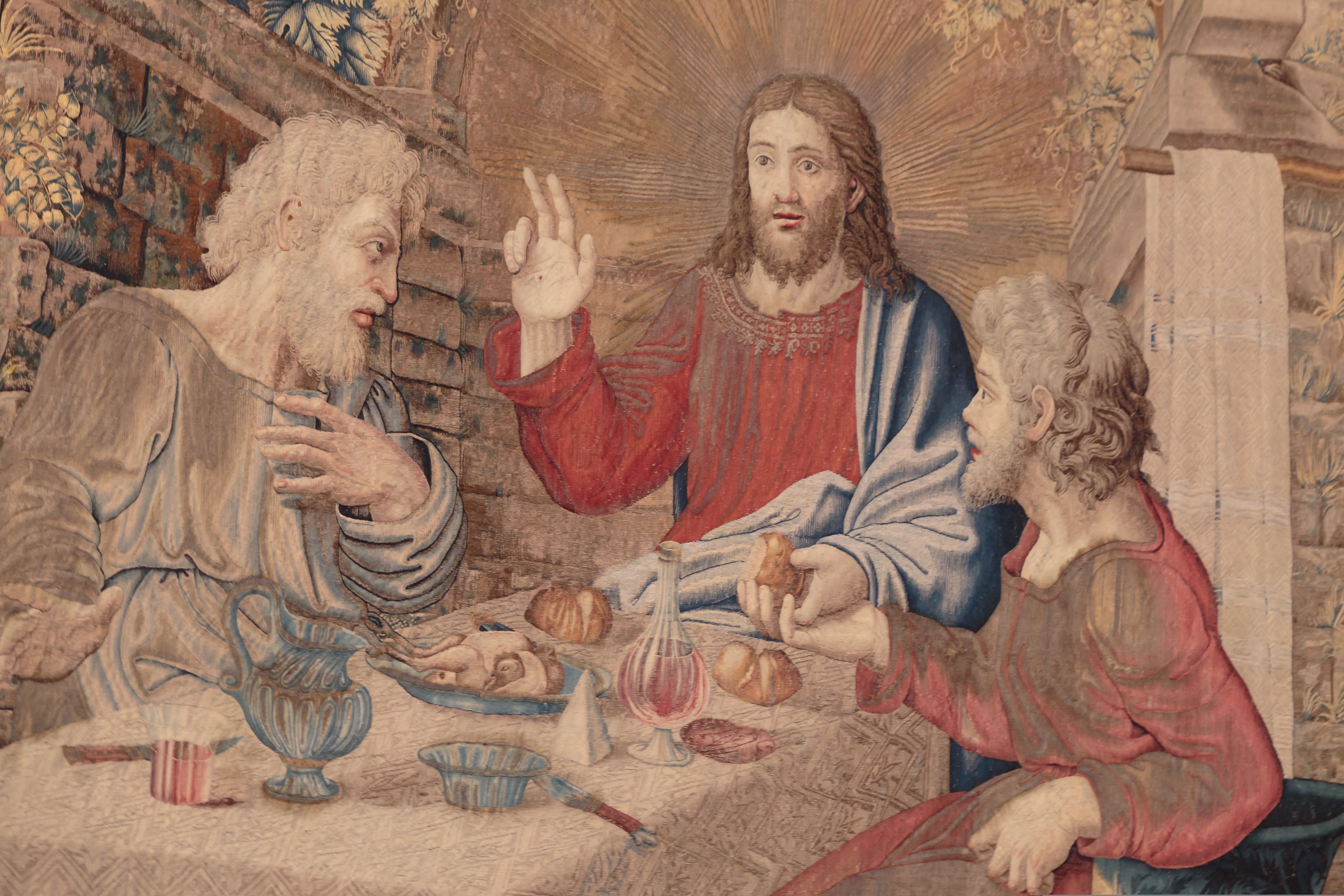
I suppose peace is a possibility — world peace, national peace, community peace, domestic peace, inner peace? But that probably would have gone nowhere if their audience simply considered their life circumstances. Yes, there was the Pax Romana (Peace of the Roman Empire), but that was just another way of acknowledging that Roman power prevented those under its control from fighting one another. War wasted the money and resources that were supposed to go to Rome.
You might guess that they preached caring for the widow and the orphan, but that message had been inadequately received (and commonly ignored) since it was first introduced.
Justice? Was Justice the word they preached? Doubt it. Sure, Justice was seen as one of the hallmarks of the coming messiah, but there was little these immigrants from Israel could do to effect its actual practice in the Roman world.
How about preaching social equality? That’s probably the most laughable of the suggestions offered. The empire was a social world where slaves were common, where there were the elite and the scum, where authority rested with the rich and powerful, where there was among the populace a “top” and a “bottom” with practically nothing in between.
Do I get points for telling you something new? Probably not.
We have a good idea of what these early Christians preached, what message they brought to others. We know this from the preaching of both Peter and Paul, as recorded in the Scriptures.
“Since all have sinned and fall short of the glory of God, they are justified by his grace as a gift, through the redemption which is in Christ Jesus… “ (Romans 3:23-24)
“He himself bore our sins in his body on the tree, that we might die to sin and live to righteousness. By his wounds you have been healed.” (1 Peter 2:24)
“For as by a man came death, by a man has come also the resurrection of the dead. For as in Adam all die, so also in Christ shall all be made alive.” (1 Corinthians 15:21-22)
It is this message, of course, that these migrating Jews brought with them and proclaimed in their new communities. Nothing new here! Why the fuss?
The issue before us is the result of two thousand years of cultural evolution, and it is pernicious if overlooked. Pernicious because it subtly undermines the foundational truth of our faith.
It is well and good to exhort people to peace. A just society is one we should all strive for. The pursuit of social justice is an endeavor all should work for. The elimination of world hunger is also a goal within reach, yet it seems evermore elusive.
But why do I say these things as if they are self-evident norms? They are not universally accepted truths, and some Western philosophers suggest better alternatives.
Nietzsche proposed that the will to power should be in control. Darwin would suggest the survival of the fittest. Jean Paul Sartre told us that the self should guide all. Among these and other philosophers, Marx would offer complete, absolute, total, and comprehensive equality.
It is interesting to note that all of these have their beginning and their end in our humanity. So too is it possible for the pursuit of justice, peace, social equality, and the like. These, too, can have their beginning and their end in our humanity, and that’s a matter of some concern. For if our humanity is the foundation, then the ‘good’ can quickly change. And that pernicious issue previously referred to is already unfolding. It is this: Christianity may well survive even if there are no Christians.
In a subtle way, the consequences of the Christian Faith have themselves become their own reason for being. When those early Christians left Jerusalem for other towns and cities, they preached the gospel of God becoming man, of His love for mankind, His proclamation of the forgiveness of sin, and His willingness to die so we could have eternal life. All else followed from this foundational truth. God loves us; therefore, we should love one another. We do so, not because it is the human thing to do, but because it is the God-like thing to do.
If we forget that, then Christianity may well survive even if there are no Christians. Then mankind will discover that, in its distortion, it is not Christianity after all.