

By Tim Trainor
Jesus is clearly saying here that being on the “inside” is not just a matter of location but of relationship. That relationship is not by blood, but by identification with “the Way” that Jesus is teaching them. To be a Christian is to enter a new family with stronger ties than those of blood, where everyone is seen as a brother or sister.
Tuesday of the Third Week in Ordinary Time
2 Samuel 6:12b-15, 17-19
Mark 3:31-35
In today’s reading from 2nd Samuel, chapter 6, we see David, now successfully, bringing the Ark of the Covenant to Jerusalem with immense joy, priestly reverence, and public sacrifice, marking a sharp shift from his previous, careless, and disrespectful loading of the Ark on a cart, as if it were common cargo.
These six things stood out to me in this Old Testament reading.
This time, David follows Mosaic Law (per Numbers 4) by having Levites carry the Ark on their shoulders to maintain its holiness.
Frequent Sacrifice: Catholic commentators, such as Haydock, note that David offered a sacrifice every six paces as a sign of his extreme caution and atonement for his earlier transportation error.
David as a Priest-King type of model (see v. 14, 17-18).
Please note that Catholic tradition often views David’s actions here, in this event, and elsewhere, as a type (a foreshadowing) of Christ, the true High Priest and King long promised by God. Concerning God’s presence (dwelling place) in the Ark and later in the Eucharist. The whole procession of bringing the Ark—the dwelling place of God’s presence into the heart of the kingdom (Jerusalem) should be seen here, I believe, as a pre-figurement of the New Covenant, where the Lord dwells among His present-day people in the Eucharist.
The Holy Abandonment that David’s “leaping and dancing” shows is a total surrender to joy in the Divine Presence. Bishop Barron and other commentators emphasize that David’s dance was not for self-glory but to honor God.
Lastly, the distribution of bread, meat, and raisin cakes to “the whole multitude” serves as a biblical model for communal celebration (as in the Eucharist) and other hospitality in a liturgical/church event. These acts should ensure that every person—man and woman—shares in the physical and spiritual blessings of God’s presence.
Our Gospel reading from Mark contains an incident that many people back in Jesus’ day would have found rather puzzling. Jesus’ mother and his “brethren” (male relatives like cousins who, according to other sources, were not Mary's biological children) show up to see him.
They can’t join Jesus inside because the house is too crowded, so they have to stand outside and send him a message. “(The) crowd seated about him said to Him, ‘Your mother and your brethren are outside, asking for you.’” [Mark 3:32].
At this point, the ‘expected’ thing would be for Jesus to drop everything and either go see them or arrange for them to be brought to him — because they are “Family.” That would be what would be expected, back then, of Him as a dutiful son on good terms with His ‘family/kin’. Instead, Jesus does something quite ‘unexpected’:
He replied, “Who are My mother and My brethren?” And looking around on those who sat about him, He said, “Here are My mother and My brethren. Whoever does the will of God is My brother, and sister, and mother” [Mark 3:33-35].
What are we to make of this? What is Jesus really saying and doing here in our Gospel? I believe there are at least five things happening here for us to explore and see how Jesus uses each to teach us a needed spiritual lesson.
1. First, we know that many of Jesus’ natural family already thought that He may have become mad (See Mark 3:21) and that He thereby had become an embarrassment to them. So now they come to the house where Jesus is teaching, and, standing outside, send in a message asking for him. Do they just want to talk with him or perhaps even try again to remove him from these strange new non-carpenter-son things that He is now doing?
In any case, Jesus uses this opportunity to teach us a very important lesson: “Whoever does the will of God is my brother and sister and mother,” or, in modern terms, is part of an expanded family-like unity with Him.
We should note that Jesus’ family is described twice in Mark as being on the “outside.” They are therefore “outsiders.” By contrast, those sitting in a circle with Jesus in the classic learning position, per Church Fathers' commentary, are on the “inside”—thus they can not only be viewed as His students but also now seen to be the “insiders” in every sense of that word.
Also, I believe Jesus is clearly saying here that being on the “inside” is not just a matter of location but of relationship. That relationship is not by blood, but by identification with “the Way” that Jesus is teaching them. To be a Christian is to enter a new family with stronger ties than those of blood, where everyone is seen as a brother or sister. Thus, an “insider” is now to be defined simply as anyone “who does the will of God.”
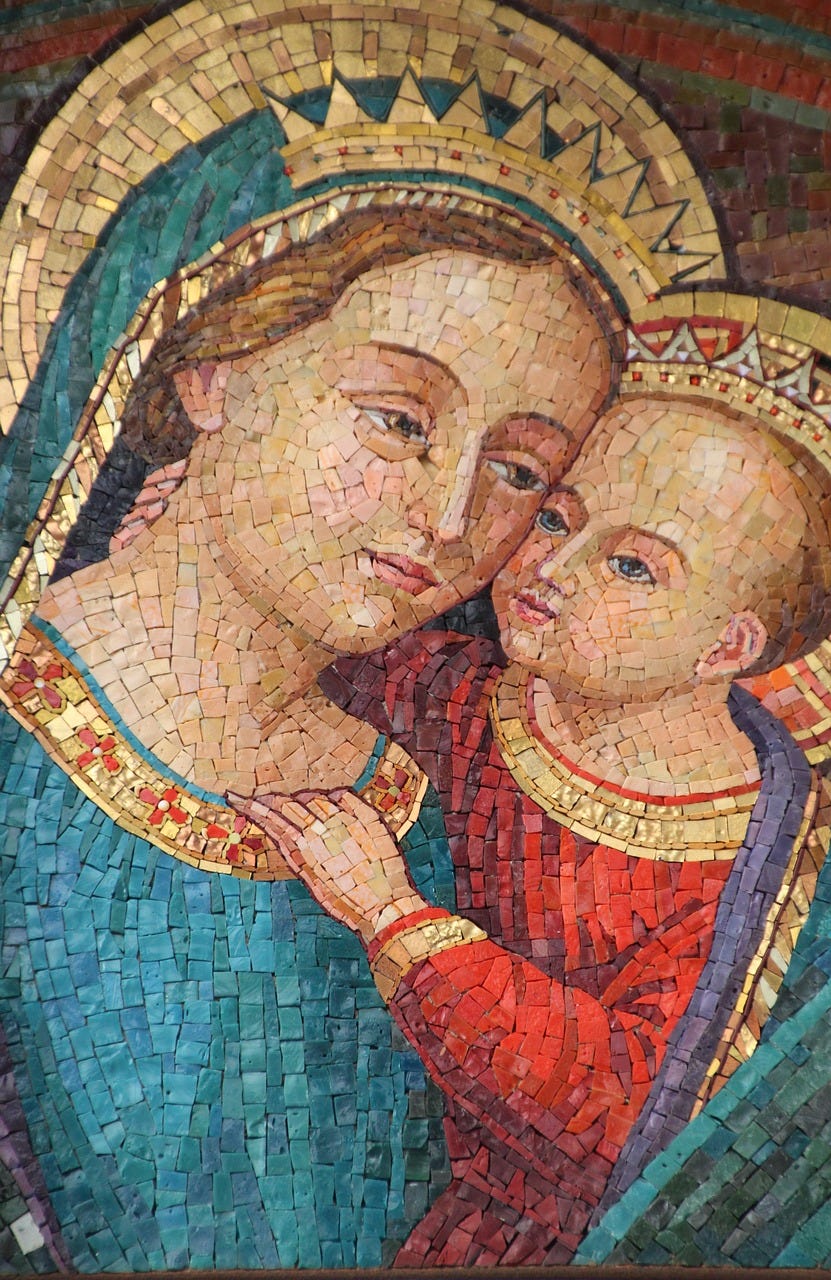
2. A disturbing question that might arise from this passage is the status of Jesus’ mother, Mary. Is she also to be classified as an “outsider”? The answer is an unequivocal no. We know from Luke’s Gospel that, when invited by the angel to be the mother of Jesus, Mary gave an unconditional “Yes” to the will of God by saying:
“Here am I, the servant of the Lord; let it be with me according to your word.” (Luke 1:38)
This was her ‘Magnificat’ or total surrender to the will of God, and it was something that she never withdrew through all the difficulties she experienced. And most of all, held to it when the “sword of sorrow” pierced her heart as she saw her own Son’s heart pierced on the Cross. She was with him to the very end and would finally get to share His joy in the Resurrection.
So, Mary is definitely on the “inside,” not because she was the mother of Jesus, but because of her total identification with His mission and being with Him from the beginning to the very end.
3. Jesus’ action raises a deep question for us to ponder: What now is His family, and who is in it?
Natural family ties are important, which is why God enshrined “Honor thy father and mother” in the Ten Commandments, but they aren’t of ultimate importance here.
What is of utmost importance is our spiritual relationship to God, and so Jesus indicates that being part of the ultimate family of God –the group of those who do God’s will– is much more important than having merely natural or family ties. The Catechism defines this ultimate family of God as what we now call “The Church” (see CCC 751-780, 830-831).
4. Since Jesus identified the criterion that makes one a member of His ultimate family, it has been natural for people to ask how Jesus’ own natural family measured up to it.
As previously mentioned, we know that his mother responded perfectly to God’s will. We also know that many of his brethren (such as His cousins James and Jude) went on to play prominent roles in the Church, so they responded well and are now “on the inside.”
5. Lastly, as interesting as it may be to know whether a given member of Jesus’ own natural family is part of His ultimate family, inside The Church is, it isn’t Jesus’ main lesson before each of us this morning.
The big, main lesson that Jesus desires each one of us individually to undertake is in the form of a question. He wants each of us to ponder, and then answer the question: Where am I? Am I “inside,” listening and learning from Him, doing the will of God, or am I on the “outside”?