

By Ron Bruni
Angels are not myths or merely poetic symbols. Sometimes we recognize God’s protection only after the danger has passed. Sometimes we recognize His guidance only after we reach the destination, and sometimes healing does not mean every illness disappears or every sorrow is removed. It means that God enters the suffering and prevents it from separating us from Him.
Feast of Saints Michael, Gabriel, and Raphael, Archangels
Daniel 7:9-10, 13-14
Psalm 138:1-2ab, 2cde-3, 4-5
John 1:47-51
The word angel comes from the Greek (angelos), meaning “messenger” or “envoy.” It did not originally describe what a being was, but what that being did: deliver a message. Its path into English was: Greek Angelos (“messenger”) → Latin angelus → Old English Engel → modern English angel.
In the Greek Old Testament—the Septuagint—Angelos usually translates the Hebrew (mal’ākh), which likewise means “messenger.” A mal’ākh could be either a human messenger or a heavenly messenger sent by God.
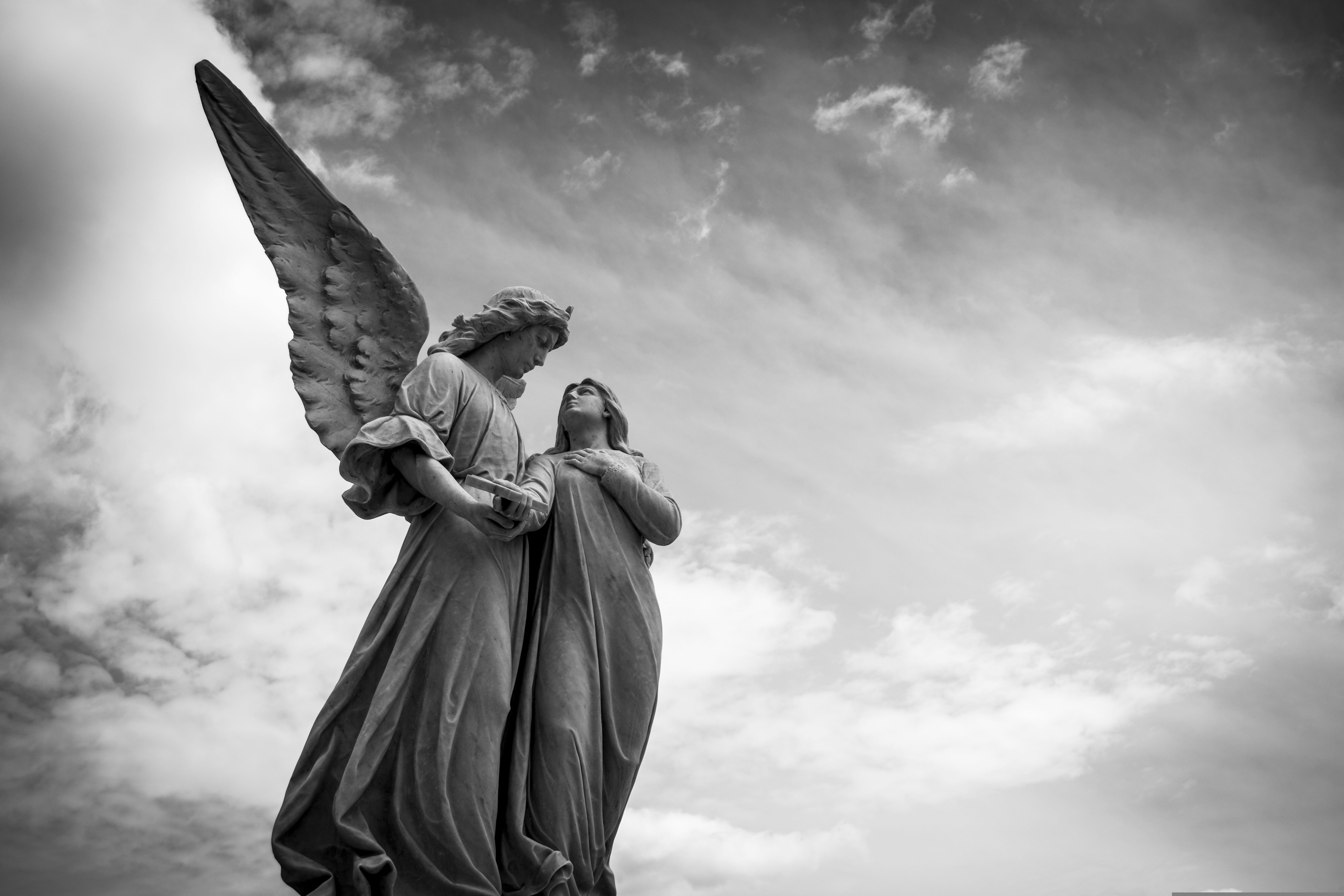
The Catholic Church teaches that angels are not myths or merely poetic symbols. They are real, personal, spiritual creatures created by God, possessing intelligence and free will but no physical bodies. They are immortal, yet they are creatures, not divine beings, and never objects of worship. They are higher than human beings in natural intelligence and spiritual power, but they remain infinitely beneath God. They do not know everything, cannot read the deepest secrets of the human heart as God can, and cannot create or perform miracles by their own power. Christianity therefore rejects two opposite errors: treating angels as imaginary decorations; or treating them almost as minor gods. They are neither. They are powerful servants of the one God.
“Angel” is the name of the office, not of the nature. In other words, by nature an angel is a spiritual creature; by office or function, he is God’s messenger. Interestingly, our word evangelize comes from the related Greek euangelion: “good message” or “good news”, the source of the word Gospel.
Angels appear throughout salvation history. They guard Eden after the fall, protect Lot, assist Hagar, stay Abraham’s hand, guide Israel, strengthen the prophets, announce births, deliver people from danger, and carry messages from God. The angel Gabriel announces the birth of John the Baptist and Jesus. Angels proclaim Christ’s birth, minister to him after his temptation, strengthen him in Gethsemane, announce the resurrection, and appear at his ascension.
The familiar nine choirs of angels do not appear as a complete list in any one passage of Scripture. Around AD 500, the Christian writer known as Pseudo-Dionysius gathered biblical names for heavenly beings and arranged them into a spiritual hierarchy. Scripture supplied the names; Christian tradition supplied earlier reflection; and Neoplatonic philosophy supplied much of the structure.
The biblical foundation plays out like this:
Isaiah describes the Seraphim;
Genesis and Ezekiel describe the Cherubim;
St. Paul names Thrones, Dominions, Principalities and Powers;
Jude and First Thessalonians mention an Archangel;
And, Angels appear throughout Scripture as God’s messengers.
St. Paul, however, does not give these beings a numbered order. His central point is that Christ created every visible and invisible power, and they remain subject to Him.
Pseudo-Dionysius divided them into groups of three because Neoplatonism influenced him, which pictured reality as ordered levels proceeding from the highest source and returning toward it. He transformed this into a Christian vision: creation receives God’s light and love and shares it through ordered ministries. The threefold pattern also suited his recurring spiritual movement of purification, illumination and perfection.
The nine Choirs of angels proposed by Pseudo-Dionysius were:
First triad, closest to God: Seraphim, Cherubim and Thrones - associated with burning love, divine knowledge and receptivity to God’s judgment.
Second triad, ordering creation: Dominions, Virtues and Powers - associated with spiritual authority, divine strength and the defense of heavenly order.
Third triad, closest to humanity: Principalities, Archangels and Angels - associated with peoples and communities, great divine announcements and personal ministry.
Pseudo-Dionysius was not primarily describing nine celestial job classifications. The ranks represented differing ways of receiving, reflecting, and communicating God’s truth. The nearer a creature is to God, the more fully it shares in divine illumination and helps draw those below it toward God. Later, St. Thomas Aquinas refined this scheme, and Dante gave it memorable poetic form.
Today, we most often picture angels as gentle figures decorating Christmas cards, beautiful, peaceful, and safely removed from the difficulties of ordinary life. But that is not the picture presented in today’s readings from Daniel chapter 7, Revelation chapter 12, Psalm 138, and chapter 1 of John’s Gospel.
Daniel sees the throne of God surrounded by countless heavenly servants.
Revelation describes Michael and his angels struggling against the Dragon.
And Jesus tells Nathaniel that he will see “heaven opened and the angels of God ascending and descending on the Son of Man.”
These are not sentimental images. They reveal that an unseen spiritual reality surrounds our visible world. Heaven is not merely somewhere far away. It is already touching the earth, and Christ is the point where the two meet.
The names of the three archangels tell us something important about how God enters human life.
Michael means, “Who is like God?”
It is not merely a name; it challenges every form of pride. The dragon’s temptation is always the same: to place ourselves where God belongs, to decide for ourselves what is true, what is good, and what is permitted.
Michael’s very name exposes that illusion: Who is like God? No political power, no human ideology, no scientific achievement, and no individual ego can take God’s place. Michael reminds us that evil is defeated not by becoming more powerful than God, but by surrendering ourselves to God’s power.
Gabriel means, “God is my strength”.
Gabriel appears when God has a message that will change history. He announces the birth of John the Baptist, and then he comes to Mary with the astonishing news that she will become the mother of the Messiah. Yet Gabriel does not compel Mary. He delivers God’s word and waits for her response. This is significant. God’s power does not ordinarily force itself upon us. It calls, invites, and waits. Opened the door through which Christ entered the world. In much the same way, every Christian is asked to give God a place to enter the world through us, through our words, our choices, our forgiveness, and our care for one another.
Raphael means, “God heals.”
In the Book of Tobit, Raphael accompanies a frightened young man on a dangerous journey. Only later is his true identity revealed. God’s healing had been present all along, even when the traveler did not recognize it.
That may be one of the most consoling truths of this feast today: God may be working in our lives long before we understand what he is doing.
Sometimes we recognize God’s protection only after the danger has passed. Sometimes we recognize His guidance only after we reach the destination, and sometimes healing does not mean every illness disappears or every sorrow is removed. It means that God enters the suffering and prevents it from separating us from Him.
Then, in the gospel, Jesus tells Nathaniel: “You will see heaven opened and the angels of God ascending and descending on the Son of Man.” Jesus is recalling Jacob’s dream of a ladder joining earth and heaven. But now Jesus himself is the ladder. He is the meeting place between humanity and God. Through him heaven has been opened, not merely to angels, but to us.
Perhaps the deepest message of today’s feast is therefore not simply that angels exist. It is that God has not left us alone. When evil things are powerful, Michael reminds us that evil does not have the final word. When we do not know what to do, Gabriel reminds us to listen for God’s word. When we are wounded, frightened, or traveling through uncertainty, Raphael reminds us that God may already be walking beside us.
We may never see an angel in the form artists imagine. But we may recognize an angelic ministry whenever truth defeats deception, courage overcomes fear, a word of hope reaches someone in despair, or healing begins in a wounded heart. And perhaps God sometimes asks us to perform that ministry for one another.
We can become “Michael” when we stand against evil without becoming evil ourselves. We can become “Gabriel” when we speak a word of truth, hope, or encouragement. We can become “Raphael” when we accompany someone who is suffering and help that person discover that God has not abandoned them.
The angels do not draw attention to themselves. Their entire purpose is to point beyond themselves towards God. That is also the calling of every Christian. The question is not simply, “Do I believe in angels?” The more challenging question is: do I live as though heaven is truly open, Christ is truly present, and God is still working; within me, around me, and sometimes through me?
The feast of the archangels assures us that the struggle is real, but so is God’s protection. The journey may be difficult, but we do not travel alone. Heaven may be invisible, but it is much closer than we think.
And in the end, Michael’s question will receive its final and everlasting answer: “Who is like God?” … No one!
Lord God, send Michael to defend us from evil, Gabriel to help us here and answer your word, and Raphael to accompany us along the road of healing. Open our eyes to Your presence in the ordinary moments of our lives. Make us instruments of Your protection, Your message, and Your healing for others. And when the road becomes uncertain, remind us that heaven is open, Christ is with us, and we never walk alone.