


By Steve Hall
The way is long, with many a winding turn. It leads us to who knows where? Who knows where? For now, we see in a mirror dimly. Yet we know what is necessary as we move with Christ and the Spirit over the water.
Tuesday of the Thirteenth Week in Ordinary Time
Amos 3:1-8, 4:11-12
Matthew 8:23-27
“Jesus got into a boat, and the disciples followed him.”
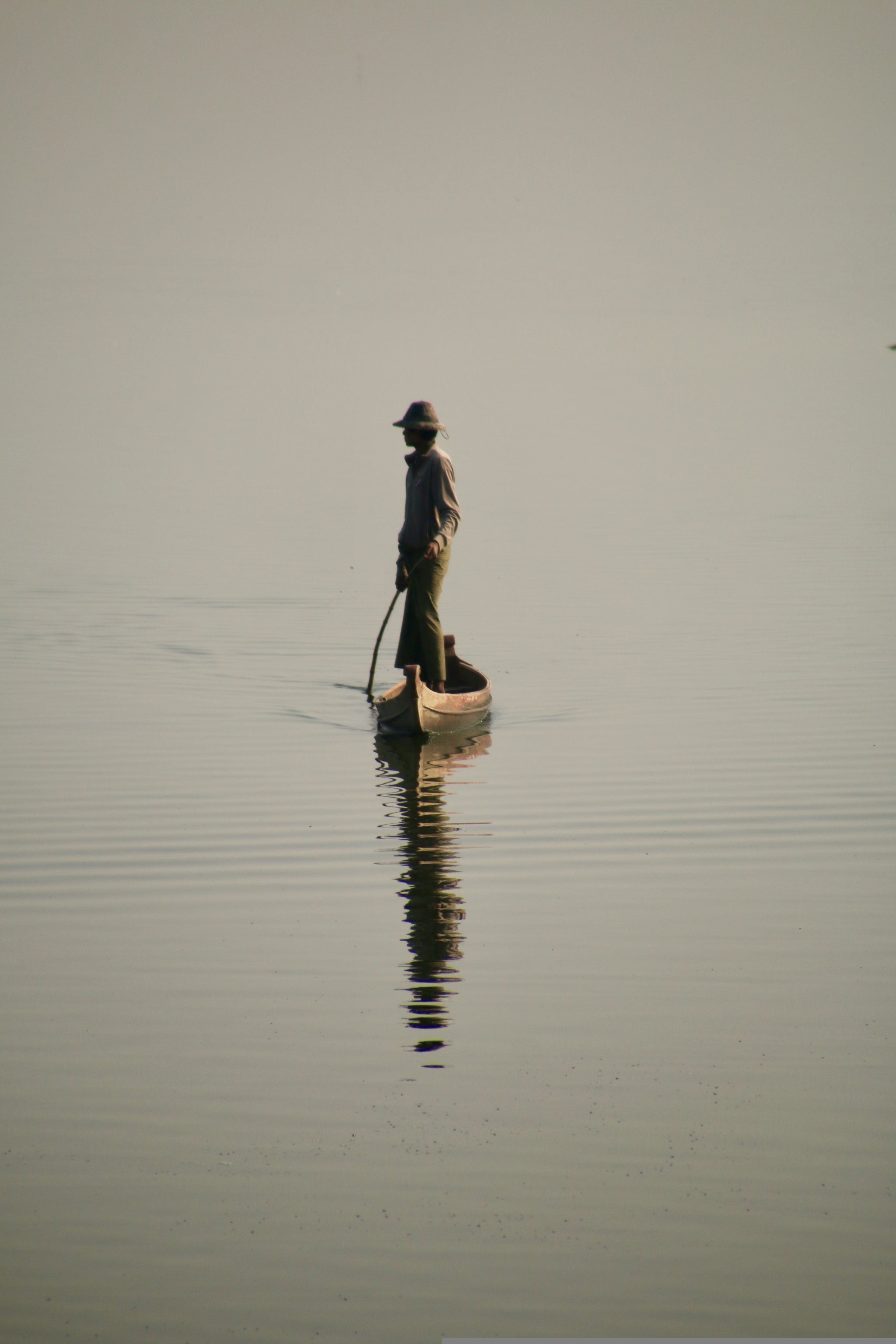
The details of the boat are not mentioned, but in Christian symbolism, the boat is a humble yet powerful image for the Church, representing a community of believers navigating life’s challenges together under the guidance of Christ. When I was younger the phrase ‘barque of Peter’ occasional floated through conversations about religion. And, while it is possible that the boat of today’s Gospel account was Peter’s own fishing boat, it is highly unlikely that it was a barque. Unlikely because, among other things, the word ‘barque’ must be French ending as it does with a ‘q-u-e;’ and the French weren’t around in Jesus’ day, only Gauls. Besides, a barque is a sailing ship of three or more masts with the aftmost mast fore-and-aft rigged and the others square-rigged.
In any case, traveling by boat on a calm sea can be peaceful and relaxing, but it can also be unsettling and make one anxious if the weather grows stormy and the waves grow high. You and I have been and are in Peter’s boat. We’ve seen both the peaceful and the anxious as we’ve journeyed.
God was not surprised by the actions of Adam and Eve. He didn’t just expect it as a possibility — he knew it would happen. It was in his plan. The ability to choose was consequential. For Adam and Eve, you might even say it was earth-shattering. All this was in the “Plan.”
Early in their journey to the Promised Land, the children of Israel were given the Law at Mt Sinai. Something that was not done for any other nation. And then they were admonished to keep it. “See, I have set before you this day life and good, death and evil. I call heaven and earth to witness against you this day, that I have set before you life and death, blessing and curse; therefore choose life, that you and your descendants may live…(Deuteronomy 30:15, 19).
Notice the stated options. The true choice was not between following the Law or not following the Law. The true choice was between life and death. That too was in the Plan. More than a thousand years of Israel’s history subsequently proved what we, sub-consciously at least, have always known was true. And it occurs to me that Israel’s inability to consistently choose life merely foreshadows what has been and always will be true: man on his own can never be persistent in choosing the good, in choosing life. The witness of history proves it. A transformation was needed. The next part of the Plan was required.
That part of the Plan — the Incarnation — was staggering in its implications and formidable in its power to achieve them. Moreover, it was promulgated in such a way that the result was incontrovertible. The Incarnate God was to die in such a way as to make the fact of his death absolutely certain. Spurious arguments to the contrary might be brought, but none could stand. He was dead. And the Plan continued to unfold: just as the crucifixion gave surety to death, the resurrection gave surety to eternal life.
Paul describes this part of the Plan in his letter to the Ephesians.
“Blessed be the God and Father of our Lord Jesus Christ, who has blessed us in Christ with every spiritual blessing in the heavenly places, even as he chose us in him before the foundation of the world, that we should be holy and blameless before him. He destined us in love to be his sons through Jesus Christ, according to the purpose of his will, For he has made known to us in all wisdom and insight the mystery of his will, according to his purpose which he set forth in Christ as a plan for the fullness of time, to unite all things in him, things in heaven and things on earth.” (Ephesians 1:3-5, 9-10)
So there we have it — Crucifixion! Resurrection! Union! Salvation!
The Law cannot save us. It never could.
So now we are in the ‘end times’ of the Plan. We struggle to live in the light revealed. We struggle to die with him so we can rise with him. We press on, as Paul says, so as to say it is no longer I who live. Christ lives in me. The plan has been clearly stated: “to unite all things in him, things in heaven and things on earth.” So when we read the text closely, it is evident that it is not just about you and me.
“Creation [itself] was subjected to futility, not of its own will but by the will of him who subjected it in hope; because the creation itself will be set free from its bondage to decay and obtain the glorious liberty of the children of God.”
“We know that the whole creation has been groaning with labor pains together until now; and not only the creation, but we ourselves, who have the first fruits of the Spirit, groan inwardly as we wait for adoption as sons, the redemption of our bodies.” (Romans 8:20-23)
The end of our journey is clear. The route is not. We echo that sentiment, as we so often do, in song. At the end of Bilbo Baggins' adventures, he seeks to return home, even then being uncertain, like us, of what the way will be.
Under cloud, beneath the stars
Over snow and winter’s morn
I turn at last to paths that lead home
And though where the road then takes me
I cannot tell.
The way is long, with many a winding turn. It leads us to who knows where? Who knows where? For now, we see in a mirror dimly. Yet we know what is necessary as we move with Christ and the Spirit over the water.
Like everyone, we “do not understand our own actions. For I do not do what I want, but I do the very thing I hate.” (Romans 7:15)
And then, with the Apostles we cry: “Save us Lord, we are perishing.”
On quiet nights, when the sea was calm, and I found myself immersed in starlight, my thoughts often became more pensive. Occasionally, in the silence that enfolds someone during a night at sea, the words of David would come to my mind.
“When I look at your heavens, the work of your fingers, the moon and the stars which you have established; what is man that you are mindful of him, and the son of man that you care for him?” (Psalms 8:3-4)
If you’ve ever had the opportunity to view the starry band of the Milky Way, you know exactly what David meant and what I have so often felt as we sailed along in the stillness of night. It was not unusual that such a wondrous vision would move to the totally unfathomable fact that God loves me.
On those occasions, it was not uncommon for my heart to flutter between wondrous belief and simple doubt that it all could be so. But I stayed in the boat. The transformation required of us in these end times is a necessary one. We think we’re riding in a boat on water.
In truth, we are riding in a boat, but there is a plan, and we’re going home.