


We are told the Spirit scrutinizes everything, even the depths of God, and no one knows what pertains to God except the Spirit of God. And we learn that not with words taught by human wisdom, but with words taught by the Spirit, describing spiritual realities in spiritual terms.
Tuesday of the Twenty-second Week in Ordinary Time
I Corinthians 2:10-16
Luke 4:31-37
After my first couple of times through today’s readings, I had some difficulty finding an obvious connection between the reading from 1 Corinthians and the Gospel reading from Luke. I went down the rabbit hole.
How did these readings get paired together?
The Church's official lectionary commission selects the readings for the Catholic liturgy, acting under the authority of the Pope and guided by the reforms of the Second Vatican Council.
In 1965, 31 experts from around the world were appointed to choose passages from the Old and New Testaments that were both clearly understandable and theologically significant for the liturgical year. For two years, the Church’s official lectionary commission studied Scripture, consulted with bishops, and met regularly to determine the best passages for each Sunday and weekday. The readings were arranged to present the story of salvation coherently, ensuring that the faithful encounter a broad range of Scripture over the year.
The Church officially approved their work in 1969 and revised it in 1981. The current Lectionary (scheduled list of approved readings) uses three-year cycles for Sundays (A, B, C) and two-year cycles for weekdays.
There are more details on guidelines, exceptions, and the like, but I’m not getting my reflection done. I didn't get a satisfactory explanation of why today's readings were paired. Perhaps I should squint a bit harder.
A common spirit
The most common word in the first reading and the Gospel is “spirit,” or some variation of the same. That should make things simple! Well, it would be simple if there weren’t so many types and spirits in the Old and New Testaments of the Bible.
Quiz time! When was the Holy Spirit first mentioned in the Bible? Answer: The second verse!
In the beginning God created the heavens and the earth. Now the earth was formless and empty, darkness was over the surface of the deep, and the Spirit of God was hovering over the waters. [Genesis 1:1-2]
The Holy Spirit, Spirit of God, or simply Spirit (with a capital “S”), is the third divine person of the Trinity, co-equal, co-eternal, and co-existent with the Father and the Son. The Holy Spirit is active in creation, inspiration of Scripture, and the life of believers. Also called the Paraclete (Advocate) and Spirit of Truth, the Holy Spirit works with the Father and the Son from the beginning to the completion of the divine plan for our salvation.
Before Jesus started his public ministry, John the Baptist told the followers who were wondering in their hearts if John was the Messiah.
John answered them all, saying, “I am baptizing you with water, but one mightier than I is coming. I am not worthy to loosen the thongs of his sandals. He will baptize you with the holy Spirit and fire.” [Luke 3:16]
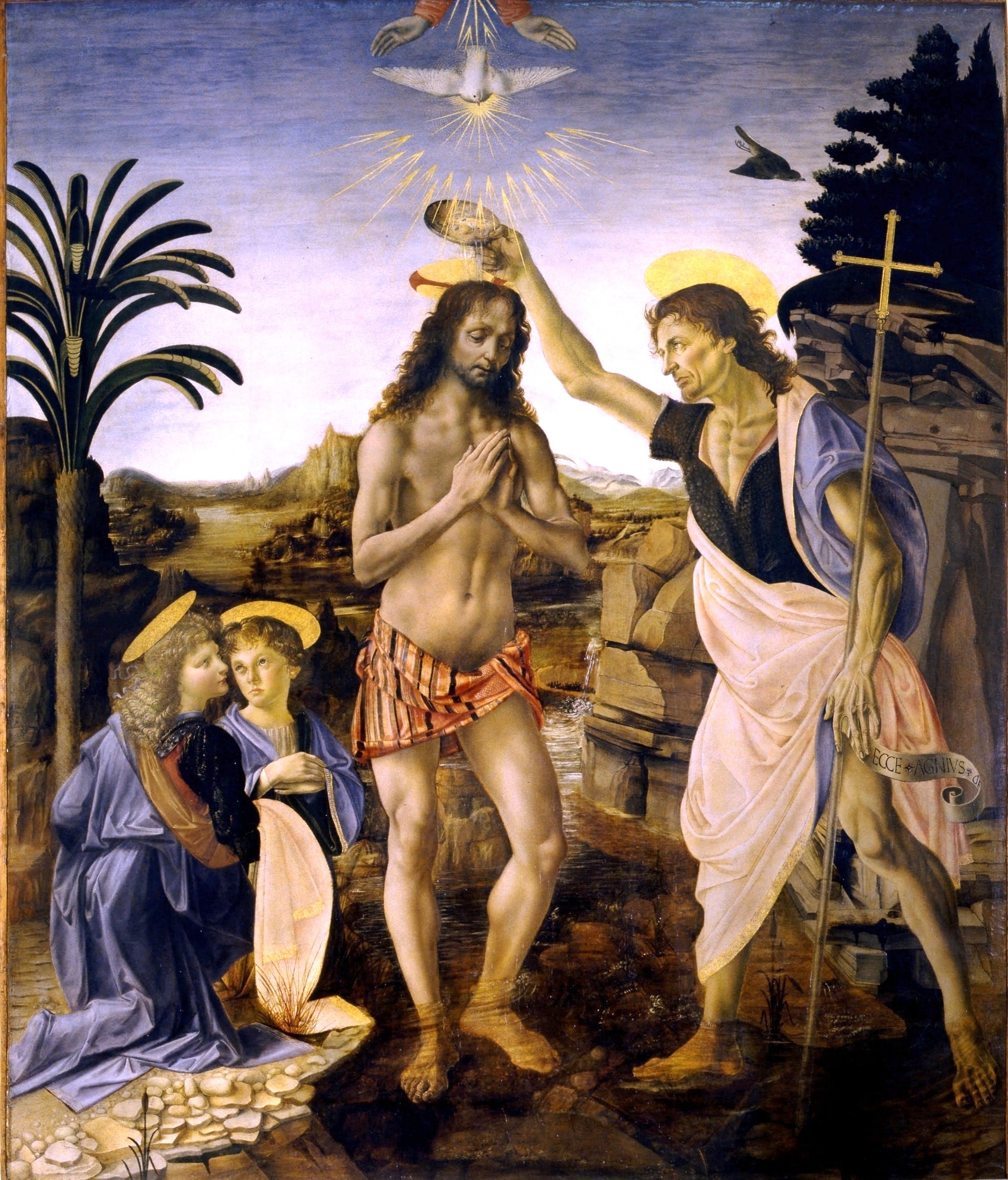
Soon after that, John baptized his followers and Jesus in the Jordan River.
After all the people had been baptized, and Jesus had also been baptized and was praying, heaven opened, and the Holy Spirit descended upon him in bodily form like a dove. And a voice came from heaven, “You are my beloved Son; with you I am well pleased.” [Luke 3:21-22]
The book of Luke continues with the genealogy of Jesus, his temptation by the devil, the beginning of his ministry in Galilee, and his rejection in his hometown of Nazareth. This leads us directly to today’s Gospel.
Jesus went down to Capernaum, a town of Galilee. He taught them on the sabbath, and they were astonished at his teaching because he spoke with authority. In the synagogue there was a man with the spirit of an unclean demon, and he cried out in a loud voice, “What have you to do with us, Jesus of Nazareth? Have you come to destroy us? I know who you are–the Holy One of God!” Jesus rebuked him and said, “Be quiet! Come out of him!”
Then the demon threw the man down in front of them and came out of him without doing him any harm. They were all amazed and said to one another, “What is there about his word? For with authority and power he commands the unclean spirits, and they come out.”
And news of him spread everywhere in the surrounding region. [Luke 4:31-37]
We have a very different spirit here, identified as an “unclean spirit” or “spirit of an unclean demon.” Elsewhere referred to as “evil spirits,” these spirits are active in opposing God’s purposes and afflicting humanity. This remarkable event happens before Jesus has begun to select his apostles. The unclean spirit causes the possessed man to cry out loudly in obvious fear of who Jesus is — “the Holy One of God.”
With a simple “Be quiet! Come out of him!” Jesus expels the demon from the man. Everyone who saw this knew that this was far beyond anything they had known about dealing with people possessed, not in their right minds. Without elaborate exorcisms and rituals, the demon obeyed Jesus' verbal commands. Where does that authority and power come from?
The Holy Spirit and the human spirit
The human spirit is the immaterial part of a person, often associated with the soul. It is the aspect of humanity that connects with God. Our spirit is also renewed and transformed through the work of the Holy Spirit.
1 Corinthians 2:10–16 teaches that true spiritual understanding comes only through the Holy Spirit, who reveals God’s deep truths to believers and enables them to discern spiritual realities that the “natural” (non‑spiritual) person cannot grasp.
Paul explains that God’s wisdom—especially the meaning of Christ’s work—is not discovered by human reasoning but revealed by the Spirit. The passage contrasts two kinds of people:
• The natural person, who relies only on human faculties and therefore sees spiritual truth as “foolishness.”
• The spiritual person, who is taught by the Spirit and can rightly evaluate spiritual matters.
We are told the Spirit scrutinizes everything, even the depths of God, and no one knows what pertains to God except the Spirit of God. And we learn that not with words taught by human wisdom, but with words taught by the Spirit, describing spiritual realities in spiritual terms.
Thus, our spiritual understanding is a gift of the Holy Spirit. Human wisdom alone cannot grasp God’s truth, but the Spirit reveals it, enabling believers to discern spiritual realities and share in the mind of Christ. Our spirit (small s) is informed and inspired by the Spirit (big S).
Speaking of spirits, why do we say “And with your Spirit?”
I became a Catholic as a young adult in 1975. By that time, the Catholic Church had transitioned from the Mass being presented in Latin to being presented in the local language, in my case, English. I learned that when the priest said, “The Lord be with you,” I responded, “And also with you.”
It comes from the translation of the greeting: Dominus vobiscum et cum spiritu tuo. Since 1970, this has been translated as: The Lord be with you. And also with you. As part of the revised translation of the Roman Missal, which updated the Mass starting in 2011, the translation of this dialogue has been revised to read: The Lord be with you. And with your spirit.
Did you know that happens 5 times in the Mass? I didn’t know exactly. But if you pay attention, you will find this exchange happens:
• During the Introductory Rites, during the greeting after the entrance song
• Just before the Gospel Reading in the Liturgy
• At the beginning of the Eucharistic Prayer
• After the Lord’s Prayer and just before the sign of peace in the Communion Rite
• In the Concluding Rites, just before the final blessing
Why has the response et cum spiritu tuo now been translated as and with your spirit?
The retranslation was necessary because it is a more correct rendering of et cum spiritu tuo. Recent scholarship has recognized the need for a more precise translation that expresses the full meaning of the Latin text.
Where does this dialogue come from?
The response et cum spiritu tuo is found in the Liturgies of both East and West, from the earliest days of the Church. One of the earliest instances of its use appears in the Traditio Apostolica of Saint Hippolytus, composed in Greek around AD 215.
How is this dialogue used in the Liturgy?
The dialogue is used only between the priest and the people, or, exceptionally, between the deacon and the people. The greeting is never used in the Roman Liturgy between a non-ordained person and the gathered assembly.
What does the priest mean when he says “The Lord be with you?”
By greeting the people with “The Lord be with you,” the priest expresses his desire that the dynamic activity of God’s spirit be given to the people of God, enabling them to do the work of transforming the world God has entrusted to them.
What do the people mean when they respond “and with your spirit?”
The expression et cum spiritu tuo is only addressed to an ordained minister. Some scholars suggest that spiritu refers to the gift of the Spirit he received at ordination. In response, the people assure the priest of the same divine assistance of God’s Spirit and, more specifically, help him use the charismatic gifts given to him at ordination and, in so doing, to fulfill his prophetic function in the Church.
We are, in fact, recognizing the priest’s ordination and encourage him to “do his priestly duties” as he tends to his flock, us.
(Parts of the “And With Your Spirit” discussion above were copied from the United States Conference of Catholic Bishops website with their permission.)
We often talk about a spiritual or spirit-filled life. It’s a lifetime journey. We must open our human spirit to be informed by the Holy Spirit, while rejecting the demons and unclean spirits of the world. The Holy Spirit that has been there from the beginning is with us now and will guide us to everlasting life.
In Revelation 22:17, the very last chapter of the Bible, the Holy Spirit reaches out to us:
The Spirit and the bride (the Church) say, “Come.” Let the hearer say, “Come.” Let the one who thirsts come forward, and the one who wants it receive the gift of life-giving water. [Revelation 22:17]
We have been invited!